

Why Your Books Fell Apart During Tax Season (And How to Fix It Now)
The Moment After Filing
You submitted your taxes. For a day, it felt done. Off your plate. Finally.
Then you start thinking back on what it actually took to get there.
You remember jumping between emails trying to find missing receipts.
You remember second-guessing numbers you weren’t fully sure about.
You remember delays, back-and-forth messages, and that constant feeling that something might be missing.
At some point, a simple thought crossed your mind:
“There’s no way I’m doing this again next year.”
That moment matters more than it seems.
Because what made tax season stressful wasn’t the deadline.
It wasn’t the forms. It was the fact that your numbers weren’t ready.
Here’s the part most business owners miss:
Tax season didn’t create the problem. It exposed it. And if nothing changes now, the same pattern quietly resets… until next year.
Tax Season Doesn’t Break Your Books. It Reveals Them
It’s easy to blame tax season. The deadlines are tight. The requests feel endless. Everything becomes urgent at the same time.
But tax season didn’t create the chaos.

It just forced everything into the light. Your bookkeeping system runs all year. Quietly. In the background. Whether it’s organized or not.
If things felt messy in March or April, it’s because they were already messy in October… and July… and January.
Tax season simply removes the ability to ignore it. That’s when gaps show up.
Transactions that were never recorded.
Expenses that weren’t categorized properly.
Accounts that were never reconciled.
Instead of reviewing your numbers, you’re rebuilding them. Instead of making decisions, you’re trying to catch up.
And that’s where the pressure comes from.
Not the complexity of taxes.
But the lack of structure leading up to them.
This is why two businesses with the same size and activity can have completely different tax experiences. One reviews and files. The other scrambles and reconstructs. The difference isn’t effort.
It’s the system behind the numbers.
The 5 Reasons Your Books Fell Apart
If tax season felt chaotic, it usually comes down to a few consistent patterns.
Most business owners don’t notice them during the year. They build slowly, then show up all at once when it’s time to file.
Here are the most common reasons your books didn’t hold up.
1. You Only Look at Your Numbers During Tax Season
For many business owners, bookkeeping becomes a once-a-year task.
You stay focused on operations, sales, and day-to-day work. Finances get pushed aside until they become unavoidable.
By the time tax season arrives, you’re not reviewing your numbers. You’re trying to understand months of activity all at once.
That’s where confusion starts.
Without regular visibility, small gaps turn into larger issues. Missing entries, unclear balances, and incomplete records all surface at the same time.
What this leads to:
Delays in filing
Uncertainty in your numbers
Increased reliance on last-minute fixes
2. Your Bookkeeping Is Always “Catch-Up Work.”
When bookkeeping is delayed, it doesn’t stay small.
A few missed weeks turn into months. Transactions pile up. Details get harder to remember.
By the time you sit down to organize everything, you’re no longer recording accurately. You’re reconstructing.
That’s when errors happen. And during tax season, this backlog becomes pressure.
Instead of moving forward, you’re constantly looking backward.
Signs this is happening:
You block entire days just to “update everything.”
You rely on bank statements instead of detailed records
You feel behind before you even start
3. You Don’t Have a Clear System
Effort isn’t the issue for most business owners.
Structure is.
Without a defined process, bookkeeping becomes inconsistent. Some things get recorded. Others don’t. Categories change. Methods vary month to month.
Over time, that inconsistency breaks reliability.
When your accountant reviews your books, they’re not working with a clean system. They’re working with mixed inputs.
That slows everything down.
A clear system means:
Transactions are recorded the same way every time
Categories are consistent
Reviews happen on a fixed schedule
Without that, accuracy becomes difficult to maintain.
4. You Rely on Memory Instead of Records
It’s easy to assume you’ll remember what a transaction was for.
At the moment, it feels obvious. A few months later, it isn’t.
This is where many small gaps come from. Not because the expense wasn’t valid, but because it wasn’t documented properly.
During tax season, that creates friction. You pause. You think. You try to recall.
Sometimes you guess.
And that uncertainty affects both accuracy and confidence.
Common results:
Missing receipts
Unclear expense classifications
Time lost verifying past decisions
5. No One Owns the Financial Process
When bookkeeping doesn’t have clear ownership, it becomes optional.
You handle it when you can. Or you delegate parts of it without a defined structure. But without accountability, consistency breaks.
Tasks get delayed. Reviews don’t happen. Issues go unnoticed.
And when tax season arrives, everything that was deferred shows up at once.
This often looks like:
“I’ll get to it later” became a pattern
Multiple people touching the books without coordination
No clear point of responsibility
If you recognize more than one of these, that’s normal.
These aren’t isolated mistakes. They tend to show up together.
And they connect directly to the broader issue of How bookkeeping mistakes build over time and surface under pressure
What This Actually Costs You
When bookkeeping breaks down, the impact isn’t always obvious at first.
It doesn’t show up as a single big mistake.
It shows up in small, repeated losses that add up over time.

You Pay More in Taxes Than You Should
When your records aren’t clear, deductions get missed.
Not because they don’t exist. Because they aren’t documented properly or are easy to verify. So instead of claiming everything you’re entitled to, you play it safe.
And “playing it safe” often means overpaying.
You Make Decisions Without Clear Numbers
During the year, your books should tell you:
How profitable you are
Where your money is going
What you can afford to invest
When your records are incomplete, those answers don’t exist.
So decisions become guesswork.
You delay hiring.
You hesitate on investments.
You move forward without full clarity.
And over time, that slows growth.
You Lose Time When It Matters Most
Tax season should be a review process.
Instead, it becomes a reconstruction project.
You spend hours:
searching for documents
verifying transactions
responding to back-and-forth requests
Time that could be spent running your business gets pulled into admin work.
And it always happens at the worst time. When deadlines are close, and pressure is high.
You Carry Ongoing Mental Load
Even outside tax season, disorganized books don’t disappear.
They sit in the background.
You know things aren’t fully updated.
You know something might be missing.
So there’s always a level of uncertainty.
It shows up in small ways:
hesitation when looking at your numbers
discomfort during financial discussions
avoidance of reports altogether
That constant low-level pressure adds up.
A Simple Scenario Most Business Owners Recognize
You’re sitting with your accountant.
They ask a straightforward question:
“Do you have records for this expense?”
You pause.
You think back.
You check your email.
You try to remember where it came from.
And your answer becomes:
“I’ll need to check.”
That moment is where all the small gaps come together.
Not as one big failure.
But as a system that wasn’t built to support you when it mattered.
Disorganized books don’t just make tax season harder.
They cost you money.
They cost you time.
And they keep you operating without full control.
What a Stable System Looks Like Instead
A stable bookkeeping system doesn’t feel complicated.
It feels predictable.
Your numbers are updated regularly, not all at once.
Transactions are categorized consistently.
When someone asks for a report, you already have it.
There’s no scrambling to find information.
No guessing what a number represents.
Tax season becomes a review, not a rebuild.
You’re not trying to reconstruct the past.
You’re working with numbers that have been clear all along.
That’s the difference.
Not more effort.
Just a system that runs before pressure shows up.
How to Fix This Before Next Tax Season
You don’t need a complete overhaul. You need a few changes that prevent the same breakdown from happening again.
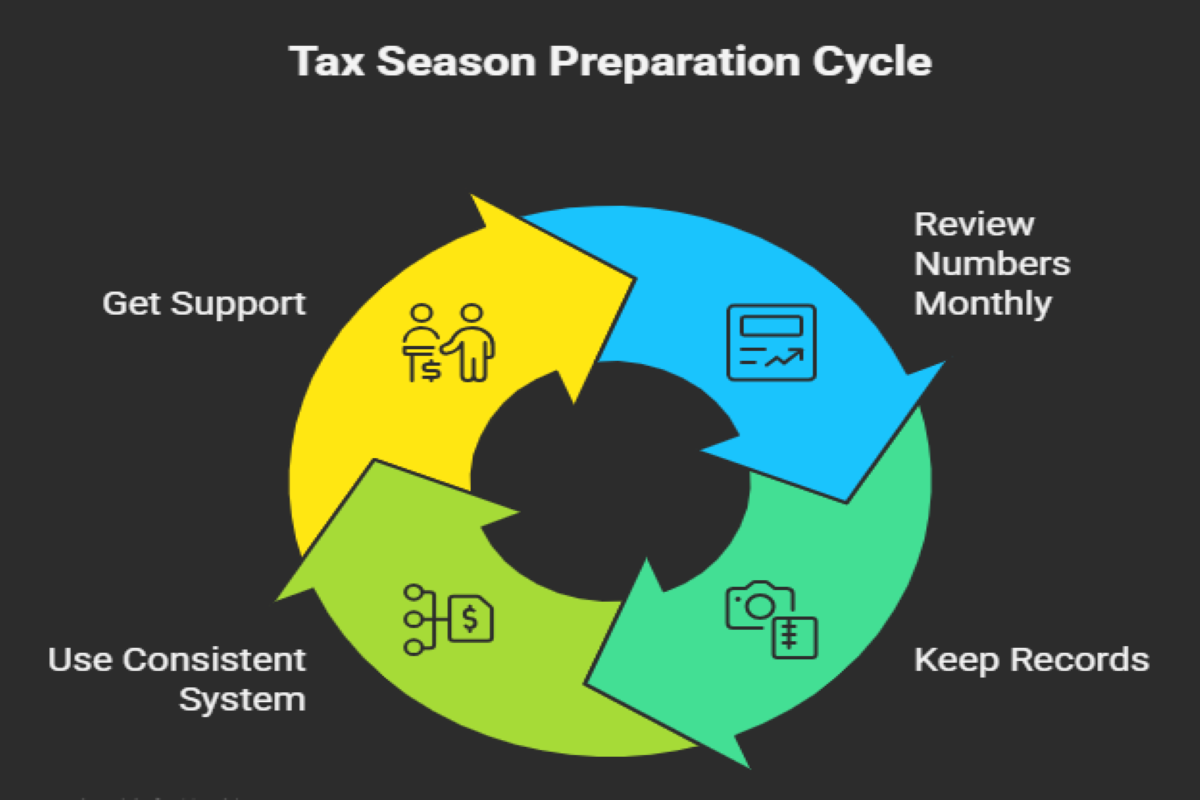
1. Review Your Numbers Monthly
Stop treating bookkeeping as a once-a-year task.
Set a fixed time each month to:
review transactions
check balances
spot missing entries
This keeps small issues from turning into large ones.
2. Keep Records as You Go
Don’t rely on memory.
When a transaction happens, record it properly. Attach the receipt. Categorize it correctly.
It takes minutes in the moment. It takes hours if you delay it.
3. Use One Consistent System
Pick a structure and stick to it.
same categories
same process
same review rhythm
Consistency is what makes your numbers reliable over time.
4. Get Support Before It Breaks Again
Most businesses don’t wait until tax season to fix operations. Finances should be the same.
If bookkeeping keeps falling behind, it’s not a time issue. It’s a system issue.
Fixing it early changes how the entire year feels.
Don’t Repeat This Next Year
What happened during tax season wasn’t random. It was the result of how your finances were handled throughout the year. If nothing changes, the outcome won’t either.
But this is the one moment where you have an advantage.
Right now, everything is fresh.
You’ve just seen where the gaps are.
That makes it easier to fix. You don’t need to become an expert in bookkeeping. You just need a system that works before pressure builds. Because the next tax season isn’t far away.
It’s already being shaped by what you do now.
👉 If you want your books organized, your numbers clear, and your next tax season handled without the stress, see how our accounting services help you stay in control year-round.