
Missing Business Records for Taxes? What You Need to Find and What to Do Next
Tax preparation has started, and the questions begin.
Do you have the receipt for that equipment purchase? Where is the contractor information? Can you find the bank statement from earlier in the year?
That is when you realize something important: having transactions in your accounting software and having the records behind those transactions are not always the same thing.
A purchase may appear in the books while the receipt is missing. Income may be recorded while a related tax form has not arrived. An expense may be easy to recognize from a bank statement, but the invoice explaining what was purchased is nowhere to be found.
And missing documents are only one reason tax preparation can become difficult. If you are not sure whether you are dealing with missing records, messy bookkeeping, or a broader tax issue, our guide to identifying the accounting problem you are actually dealing with can help you separate those problems first.
That can make tax preparation feel more complicated than it needs to.
The first step is not to search randomly through every folder and email account.
It is to identify what is actually missing.
Some missing records relate to income. Others support business expenses, payroll, banking activity, assets, loans, or prior tax information. And the right next step depends on which type of record you are trying to recover.
In this guide, we will help you separate those categories, understand why the records matter, and work through practical ways to find what is missing before tax preparation moves forward.
What Counts as a Business Tax Record?
A business tax record is more than the number that appears in your accounting software.
It is the information that helps explain where that number came from.
For example, your books may show a $1,200 expense. The supporting record might be an invoice, receipt, credit card statement, canceled check, or other document showing who was paid, how much was paid, when it happened, and what the purchase was for.
The IRS generally expects business records to clearly show income and expenses, with supporting documents behind the transactions reported in the books and on the tax return.
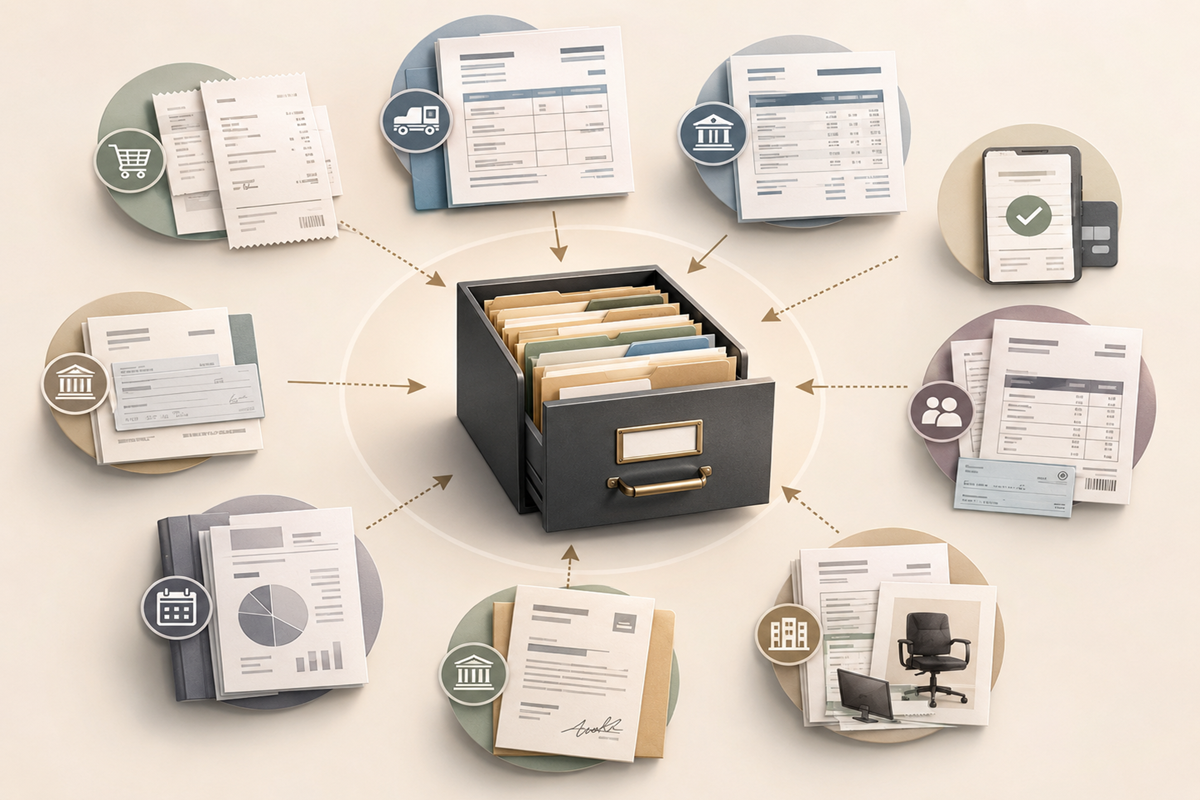
Common business tax records can include:
sales records and customer invoices
receipts and vendor invoices
bank and credit card statements
deposit records
canceled checks or other proof of payment
Forms 1099 received by the business
payroll and employment tax records
records related to equipment or other business assets
loan documents and related statements
prior tax returns and supporting schedules
Not every business will need the same set of documents.
A service business, retailer, contractor, or business with employees may each generate different records throughout the year.
The important distinction is this:
Your accounting records summarize what happened.
Your supporting documents help show why the transaction was recorded that way.
When something is missing, identifying which side of that equation has the gap makes it much easier to figure out what to look for next.
Start by Separating Missing Records Into Categories
When business records are missing, searching for everything at once can make the problem feel bigger than it is.
A better approach is to sort the missing information into a few basic categories.
Income Records
These help show what the business earned during the year.
They may include:
customer invoices
sales reports
deposit records
payment processor reports
Forms 1099 received by the business
Expense Records
These help explain business purchases and payments.
They may include:
receipts
vendor invoices
credit card statements
canceled checks
online order confirmations
subscription or service statements
Payroll Records
If the business has employees, you may also need payroll-related records, such as payroll reports, wage information, and employment tax filings.
Asset and Loan Records
Large purchases and financing often need their own documentation.
That may include purchase agreements, financing documents, loan statements, or records showing when equipment or other assets were acquired.
Prior Tax and Accounting Records
Sometimes the missing piece is not from the current year at all.
A prior tax return, depreciation schedule, year-end financial statement, or previous bookkeeping file may be needed to understand how an item should carry forward.
Once you know which category has the gap, the search becomes much more focused.
Instead of asking, “Where are all my tax documents?”
You can ask, “Which income, expense, payroll, asset, or prior-year records am I actually missing?”
What to Do If You Cannot Find a Receipt or Invoice
A missing receipt does not mean you should immediately guess what happened.
Start by trying to reconstruct the transaction from records that already exist.
Depending on the expense, useful places to check may include:
bank or credit card statements
vendor accounts or online purchase histories
emailed invoices and order confirmations
canceled checks or electronic payment records
accounting software notes or attachments
payment processor records
duplicate invoices requested from the vendor
The goal is to gather enough information to explain the transaction clearly.
That usually means identifying who was paid, how much was paid, when the expense occurred, and what was purchased or why it was connected to the business.
A bank statement by itself may show that money changed hands, but it may not explain the business purpose of the purchase.
For example, a $300 charge to a large retailer could represent office supplies, equipment, personal items, or several different purchases. Additional documentation may be needed to understand what the transaction actually represents.
If you still cannot locate the original record, do not automatically create an estimated expense just to make the books balance.
Different expenses can have different documentation requirements, and certain categories require more specific substantiation.
The practical next step is to gather the best records you have and flag anything that cannot be clearly supported for review during tax preparation.
That is much better than filling in the gap with an assumption.
What If an Income Record or Tax Form Is Missing?
Missing income records need a different kind of attention because the goal is to make sure reported income is complete.
Start by checking the records you already have.
Look at:
bank deposits
payment processor reports
customer invoices
sales reports
prior bookkeeping entries
Forms 1099 received by the business
If you expected a tax form and cannot find it, check your email, online account, or contact the payer to request another copy.
Do not assume that income can be left off simply because a form is missing.
The better approach is to compare the available records, identify what was actually received during the year, and flag any differences that need to be reviewed before the return is prepared.
The question is not only, “Do I have the form?”
It is also:
“Do my records clearly show the income the business actually received?”
Frequently Asked Questions
What if I lost a receipt for a business expense?
Start by checking bank or credit card statements, vendor accounts, email confirmations, or requesting a duplicate from the vendor. The key is to gather enough information to explain and support the transaction rather than guessing.
Is a bank statement enough to prove a business expense?
Not always.
A statement may show that a payment happened, but it may not show exactly what was purchased or why it was a business expense. Additional documentation can sometimes be needed.
What if I never received a 1099?
Do not assume the income disappears with the missing form.
Check your own records, including deposits, invoices, and payment processor reports, and request another copy from the payer if necessary.
Do I need every document before contacting an accountant?
No.
If records are missing, it can still make sense to start the conversation. A professional can help identify which documents matter most, what may be recoverable, and which gaps need more attention before filing.
Get Clear on What Is Missing Before Tax Preparation Moves Forward

Missing business records do not all mean the same thing.
Sometimes the gap is an income record. Sometimes it is a receipt, invoice, payroll document, loan statement, or prior-year record.
The most useful first step is to identify exactly what is missing and what that document is supposed to support.
From there, you can look for duplicates, check online accounts, review bank and credit card activity, contact vendors or payers, and flag anything that still cannot be explained clearly.
You do not need to have every document perfectly organized before asking for help.
If you are missing business records and are not sure what matters most, schedule an appointment with Trustway Accounting. We can help you review what you have, identify the gaps, and clarify what should be addressed before tax preparation continues.