

Messy Records, Missing Documents, or Tax Confusion: Which Accounting Problem Are You Actually Dealing With?
Tax season is getting closer, so you open your accounting software to see where things stand.
Some transactions are still uncategorized. The balance in your books does not quite match what you see in the bank. You remember a few business purchases but cannot find the receipts. Then you start wondering whether certain expenses are deductible, whether you paid enough in taxes, and whether your records are even ready to hand over to a tax professional.
At that point, everything can feel like one big tax problem.
But it may not be.
Messy bookkeeping, missing financial documents, and tax confusion are connected, but they are different problems. And knowing which one you are dealing with matters because each one has a different starting point.
Your bookkeeping may simply be behind. Your records may be current but contain errors that need to be cleaned up. The numbers may be accurate while important receipts, invoices, or statements are missing. Or your financial records may be reasonably complete, but you are unsure how those numbers affect your taxes.
You may even be dealing with several of these problems at the same time.
That is why the first question should not always be, “How do I get ready for taxes?”
A better question is:
“What is actually wrong with my financial records right now?”
Once you can answer that, the path forward becomes much clearer.
In this guide, we will help you distinguish between bookkeeping problems, missing-document problems, and tax questions so you can identify where the issue starts, what needs attention first, and what your next step should be.
Why Accounting Problems Often Look Like Tax Problems

Tax season has a way of exposing problems that were easy to ignore during the year.
A business owner may think they have a tax problem because they are unsure what they owe, what they can deduct, or whether their return is ready to file. But those questions often sit on top of something more basic: incomplete bookkeeping, inaccurate records, or missing documentation.
That is why tax confusion can be a symptom rather than the root problem.
If several months of transactions were never entered, the issue starts with catch-up bookkeeping. If the records are current but full of errors, the issue may be cleanup. If the books are reasonably accurate but receipts, invoices, or statements are missing, the problem is documentation.
Only after those underlying issues are clear does it make sense to focus fully on the tax questions.
The Tax Deadline Is Often When the Problem Becomes Visible
Many bookkeeping and documentation problems stay hidden until someone needs reliable financial information.
That usually happens when a tax return is being prepared, a loan application requires financial statements, or the owner tries to understand how the business actually performed.
At that point, problems that felt small during the year become harder to ignore.
You may discover that:
the bank balance does not match the accounting records
several months were never reconciled
expenses were categorized inconsistently
important receipts or statements are missing
income totals do not match what you expected
you cannot explain where certain numbers came from
The tax deadline did not necessarily create those issues.
It simply forced them into view.
Fixing the Wrong Layer First Creates More Work
The order matters because each problem depends on the one beneath it.
For example, trying to answer detailed tax questions while the books are incomplete can create more confusion. You may be discussing deductions before all expenses have been recorded. You may be trying to confirm income before all accounts have been reconciled.
A more practical sequence is to first determine whether the records are complete, then whether they are accurate, then whether the supporting documents are available.
Once those pieces are reliable, tax questions become much easier to answer.
So before asking, “What do I need to do about my taxes?” start with a more basic question:
“What condition are my financial records actually in?”
Problem #1: Your Bookkeeping Is Behind

Sometimes the problem is not that your books are wrong.
They are simply incomplete.
If transactions happened but were never fully recorded, you may be dealing with catch-up bookkeeping. This usually happens when bookkeeping falls behind for weeks or months and the financial activity keeps moving while the records stop keeping pace.
Signs Your Books May Be Behind
You may need catch-up bookkeeping if:
several months of transactions have not been entered
bank or credit card activity stops at a certain point in your accounting software
invoices, payments, or expenses from previous months are missing
bookkeeping was abandoned during a busy period
a new bank account or credit card was never added to the books
payroll or contractor activity has not been fully recorded
The pattern is usually straightforward: the business activity happened, but the records never caught up.
Being Behind Does Not Automatically Mean Your Books Are Wrong
This distinction matters.
A business can have accurate books through March and then have nothing recorded from April through August. The existing records may be fine. The problem is the missing period.
That is different from having twelve months of bookkeeping that is fully entered but filled with duplicate transactions, incorrect categories, unreconciled accounts, or unexplained balances.
One problem is about missing activity.
The other is about unreliable activity.
Why Catching Up Usually Comes Before Deeper Cleanup
If large periods are missing, it is difficult to judge the overall quality of the books.
You need the missing activity recorded before you can see the full financial picture. Once the books are current, you can review whether the information is accurate, whether accounts reconcile, and whether any cleanup is still needed.
That is why catch-up bookkeeping often comes first.
The practical question is: “Are my records wrong, or are they simply incomplete?”
If the answer is incomplete, catch-up work is likely the first place to start.
Problem #2: Your Books Are Current, but They Are Messy or Inaccurate
Sometimes every month is entered, every account is connected, and the bookkeeping looks complete.
But the numbers still cannot be trusted.
That usually points to a cleanup problem rather than a catch-up problem. The activity is there. The issue is that something in the existing records is inaccurate, inconsistent, duplicated, or unresolved.
Common Signs of Messy Bookkeeping
You may need bookkeeping cleanup if:
bank or credit card accounts do not reconcile
transactions appear more than once
personal and business expenses are mixed together
expenses are categorized inconsistently
old balances remain unexplained
payments are applied to the wrong invoices
income or expense totals do not match expectations
accounts receivable or accounts payable look incorrect
transactions sit in uncategorized or suspense accounts for long periods
financial reports change significantly after corrections are made
The books may technically be current, but that does not mean they are reliable.
“Everything Is Entered” Does Not Mean “Everything Is Correct”
This is where many business owners get a false sense of confidence.
You open the accounting software and see hundreds of transactions. Nothing appears obviously missing. Reports generate without errors.
That can make the books feel finished.
But bookkeeping is more than getting transactions into the system. The records also need to reflect what actually happened.
A $4,000 equipment purchase entered as office supplies is still recorded, but it may be classified incorrectly. A duplicate payment may make an expense look twice as high. An unreconciled bank account may contain missing or repeated activity that distorts the reports.
The data exists.
The question is whether the data tells the truth.
The Practical Question to Ask
A useful test is: “Can I explain where these numbers came from?”
If you cannot trace a balance back to the transactions and records behind it, that is a warning sign.
Reliable bookkeeping should allow you to understand how the numbers were built. If balances cannot be reconciled, categories do not make sense, or reports raise more questions than they answer, cleanup may be needed before you rely on those numbers for taxes or business decisions.
This is the key difference:
Catch-up bookkeeping fills in what is missing.
Cleanup bookkeeping corrects what is already there.
Problem #3: Your Books May Be Fine, but Important Documents Are Missing

Sometimes the numbers in your accounting system look reasonable.
The accounts are reconciled. Transactions are categorized. Reports appear consistent.
But when someone asks for the receipt, invoice, statement, or other document behind a transaction, you cannot find it.
That is a documentation problem.
Financial Records and Supporting Documents Are Not the Same Thing
Your accounting records show what happened financially. Supporting documents help show where that information came from.
For example, your books may show a $780 equipment purchase. That entry tells you the amount, date, account, and category used in the bookkeeping system.
The supporting documentation may include the receipt, invoice, account statement, canceled check, or another record connected to that purchase.
The transaction can exist in the books even when the document behind it is missing.
That distinction matters because complete bookkeeping does not automatically mean complete documentation.
What Types of Records May Be Missing?
The exact records you need depend on your business and the transaction involved, but common examples can include:
receipts
vendor invoices
bank statements
credit card statements
payroll records
contractor records
loan documents
asset purchase records
tax forms
prior tax returns
The goal is not to collect paperwork for the sake of collecting paperwork.
It is to make sure important financial activity can be traced back to the records that support it.
Why Missing Documents Matter
Missing documentation can make otherwise clear bookkeeping harder to verify.
You may know that an expense occurred, but without the supporting record, important details may be harder to confirm. You may need to determine who was paid, what was purchased, when the transaction occurred, or how the expense should be treated.
That becomes especially important when the records are being reviewed for tax preparation, financial reporting, or another situation where accuracy matters.
The issue is no longer, “Did I enter this transaction?”
The issue becomes, “Can I support what was entered?”
Missing Does Not Always Mean Gone Forever
A missing document may still be recoverable.
Depending on what is missing, you may be able to:
search email for digital receipts or invoices
log in to vendor accounts
download older bank or credit card statements
contact a vendor for a replacement invoice
review attachments stored in your accounting software
request copies of certain tax forms or records
The recovery process depends on the type of document and why it is needed.
For now, the important distinction is simple:
If your books are reasonably complete and accurate but the records behind certain transactions are missing, you are dealing with a documentation problem rather than a bookkeeping problem.
Problem #4: Your Records Are Reasonably Complete, but Taxes Still Confuse You

Sometimes the books are current, the accounts reconcile, and the important documents are available.
Yet tax questions still remain.
That does not automatically mean something is wrong with the bookkeeping. It may simply mean you have moved from a recordkeeping problem into a tax problem.
What Tax Confusion Can Look Like
You may have reasonably complete records and still be unsure about questions such as:
which expenses may be deductible
whether estimated tax payments are needed
how certain business purchases should be treated
what income must be reported
how payroll taxes affect the business
how the business structure affects taxation
whether you need tax preparation, tax planning, or both
whether a tax issue is simple enough to handle yourself
These are different questions from, “Are my books complete?” or “Can I find the supporting documents?”
The records may already be doing their job.
The confusion is about how those records connect to tax obligations.
This Is Where Bookkeeping Ends and Tax Questions Begin
Bookkeeping records what happened financially. Tax work looks at how those financial facts are treated under tax rules.
For example, accurate books may show that your business spent $14,200 in a particular expense category during the year.
Bookkeeping helps establish that the spending occurred and how it was recorded.
The tax question is different:
“How should that expense be treated for tax purposes?”
That distinction matters because clean records do not eliminate tax questions. They make those questions easier to identify and answer.
Better Records Lead to Better Tax Questions
When the books are messy, tax questions tend to stay vague.
You may find yourself asking: “Can I deduct things like this?”
Or: “Do I owe more taxes than I expected?”
Once the records are complete and reliable, the questions become more specific.
Instead of asking whether “something” is deductible, you can point to a defined expense, amount, date, and supporting record. Instead of wondering why taxes seem high, you can look at actual income, expenses, payroll, and prior payments.
That changes the conversation.
The goal is not to eliminate every tax question before you ask for help.
It is to make sure the financial information behind those questions is clear enough to support a useful answer.
So if your books are current, your records are organized, and the numbers make sense, but you still do not understand the tax implications, you may not have a bookkeeping problem at all.
You may simply have a tax question.
What If You Have More Than One Problem?

Accounting problems rarely stay in neat categories.
A business can be behind on bookkeeping, have inaccurate records from earlier months, and still be missing important documents. Tax season may then expose all three problems at once.
That does not mean everything needs to be fixed at the same time.
It means you need to identify the order in which the problems should be addressed.
Example 1: Your Books Are Behind and Messy
Imagine your bookkeeping stopped six months ago.
You also know that some of the earlier records contain incorrect categories and unreconciled transactions.
In this case, you have both a catch-up problem and a cleanup problem.
A practical sequence may be:
Record the missing activity.
Bring the books current.
Reconcile the accounts.
Review the complete records for errors.
Correct the issues that remain.
Trying to clean up an incomplete set of books can make the process harder because you still do not have the full financial picture.
Example 2: Your Books Are Current, but Important Documents Are Missing
Now imagine your bookkeeping is current and the bank accounts reconcile.
The problem appears when you begin gathering information for tax preparation and realize that several large purchases do not have receipts or invoices attached to them.
That is not necessarily a bookkeeping problem.
The entries may already be accurate.
The next step is to identify which documents are missing, determine whether they can be recovered, and resolve any transactions that still cannot be properly supported.
Example 3: You Are Behind, Missing Documents, and Confused About Taxes
This is where everything can start to feel like one giant problem.
You may have several months of transactions that were never entered. Receipts are scattered across email accounts, folders, and paper files. Meanwhile, tax questions are becoming more urgent because a filing deadline is approaching.
The instinct is often to start with the deadline.
But the more useful approach is usually to work from the foundation upward.
First, determine what financial activity is missing.
Then identify what documentation is available.
Next, bring the records into a condition where the numbers can be reviewed with confidence.
Only then can the tax questions be addressed using a clearer financial picture.
The Order Matters More Than the Number of Problems
Having several accounting problems at once is manageable when you separate them into layers.
Ask:
What information is missing?
What information is already recorded but may be wrong?
What supporting documents are unavailable?
What tax questions remain once the financial records are reliable?
That sequence helps prevent one visible problem from distracting you from the issue underneath it.
If tax season feels chaotic, the goal is not to solve everything at once.
The goal is to identify which problem needs to be solved first.
A Simple Way to Identify the Problem
If you are still unsure which issue you are dealing with, start by asking a few practical questions. Are entire weeks or months missing from your bookkeeping?
If yes, you may be dealing with a catch-up problem. Are the transactions there, but the balances, categories, or reconciliations do not make sense?
That points more toward a cleanup problem.
Do the books look reasonably accurate, but you cannot find receipts, invoices, statements, or other records behind certain transactions?
That is more likely a documentation problem.
Are the books current, the records available, and the numbers understandable, but you are still unsure how those numbers affect your taxes?
Then the issue may be tax-related rather than bookkeeping-related.
And if you answered yes to more than one of those questions, that is useful information too.
It usually means you are dealing with overlapping problems that need to be handled in the right order.
A good final question is:
“Which issue has to be resolved before the others can be answered clearly?”
That is often the best place to start.
What Should You Fix First?
Once you know which problem you are dealing with, the next question is order.
That matters because accounting problems often depend on each other. You do not want to spend time answering tax questions from incomplete books or cleaning up records that are still missing months of activity.
A practical sequence usually starts with the foundation.
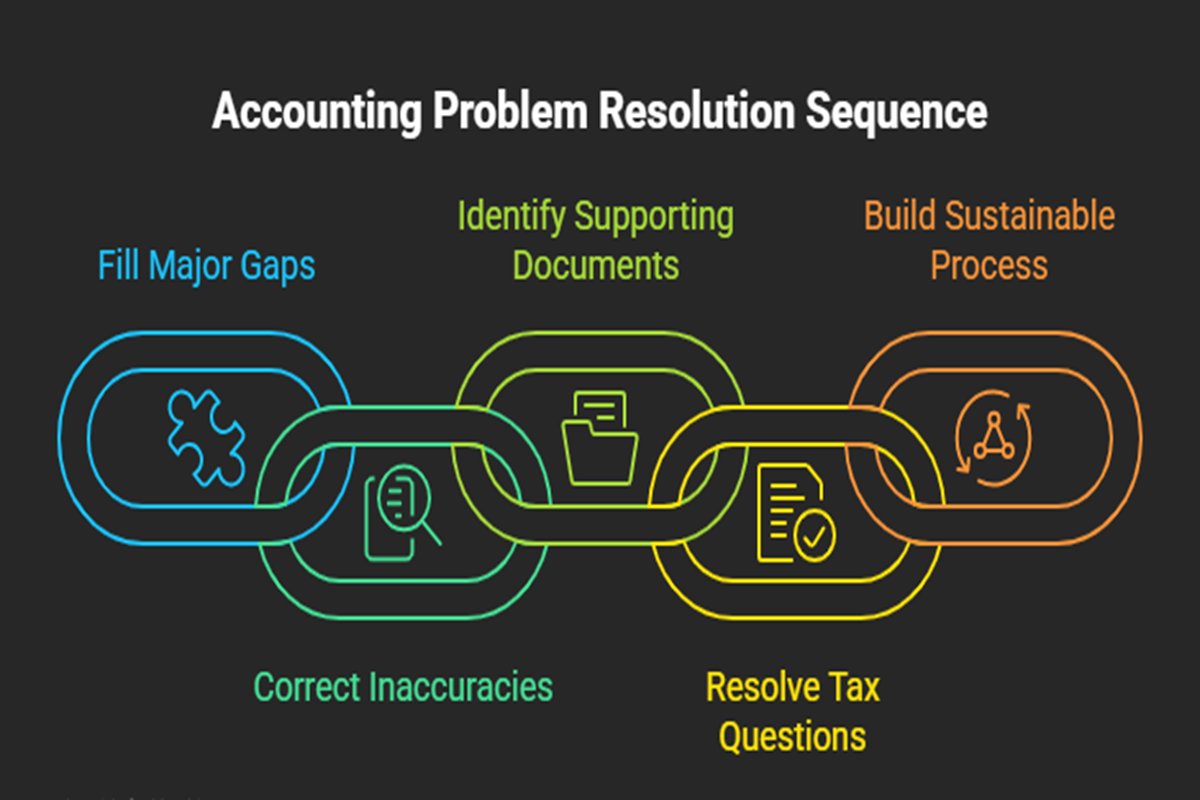
First, Fill the Major Gaps
If entire periods are missing, start there.
Bring the bookkeeping current enough to see the full financial picture. That may mean entering missing transactions, adding overlooked accounts, or reconstructing activity from bank and credit card statements.
Until the missing activity is recorded, it is difficult to know whether the existing books are accurate.
Next, Correct What Is Inaccurate
Once the records are complete, review what is already there.
Do the accounts reconcile?
Are transactions categorized consistently?
Are there duplicate entries, unexplained balances, or old items that no longer make sense?
This is where cleanup work comes in.
The goal is to move from complete records to reliable records.
Then, Identify Missing Supporting Documents
After the bookkeeping itself is in better shape, look at the documentation behind important transactions.
Which receipts, invoices, statements, or other records are missing?
Which ones can be recovered?
Which transactions still need clarification?
This step helps connect the numbers in the books to the records that support them.
Then, Resolve the Tax Questions
Once the financial records are reasonably complete, accurate, and supported, tax questions become easier to address.
Now you can ask more useful questions about deductions, estimated taxes, filing requirements, or planning because the underlying financial information is clearer.
Instead of asking vague questions about what “might” be deductible, you can look at actual transactions and actual records.
Finally, Build a Process That Keeps the Problem From Repeating
Fixing the current issue is important.
Preventing the same problem next year is better.
That usually means creating a simple routine for things like:
monthly bookkeeping
regular account reconciliations
consistent document storage
receipt capture
periodic financial reviews
tax planning checkpoints
The system does not need to be complicated.
It just needs to be consistent enough that you are not rebuilding the financial picture every time a deadline appears.
The goal is to move from reacting to accounting problems to maintaining records you can actually use.
When Should You Stop Trying to Fix It Yourself?
Some bookkeeping and recordkeeping problems are manageable on your own.
A few missing receipts, one unreconciled account, or a short period of catch-up work may be straightforward if you understand the records and know what needs to be corrected.
The situation changes when you can no longer tell whether the records are accurate or what the fix might affect.
That is usually the point where DIY becomes risky.
You may want professional help if:
more than one year of bookkeeping is incomplete
multiple bank or credit card accounts do not reconcile
personal and business transactions are heavily mixed
payroll records or payroll tax issues are involved
balances cannot be explained
important transactions are missing documentation
prior tax returns may have been prepared using inaccurate information
accounts receivable or accounts payable are unreliable
you keep making corrections without understanding why the numbers are still wrong
The important question is not:
“Can I technically fix this myself?”
A better question is:
“Do I understand the records well enough to know that I fixed them correctly?”
If the answer is no, continuing to make changes can create more uncertainty.
You may correct one entry and accidentally affect another account. You may categorize a transaction incorrectly. You may create a clean-looking report that still does not reflect what actually happened.
At that point, the problem is no longer just the amount of work involved.
It is the level of confidence you have in the final result.
The goal should be reliable financial information, not simply getting the books to look finished.
Frequently Asked Questions
Is messy bookkeeping the same as being behind?
No.
Being behind usually means financial activity has not been fully recorded for a period of time. Messy bookkeeping means the activity may already be entered, but the records contain errors, inconsistencies, unreconciled accounts, or other issues that make the numbers unreliable.
A business can also have both problems at the same time.
Can my books be current and still be wrong?
Yes.
Having every month entered does not automatically mean the bookkeeping is accurate. Duplicate transactions, incorrect categories, unreconciled accounts, mixed personal and business expenses, or unexplained balances can all create problems even when the books appear current.
The better question is whether the numbers can be reconciled, explained, and supported.
Should I clean up my books before tax preparation?
If the books contain significant errors or incomplete information, those issues generally need to be addressed before the financial information can be relied on confidently for tax preparation.
That does not mean every bookkeeping file needs to be perfect before tax work begins.
It means the records should be complete and reliable enough to clearly identify income, expenses, and other relevant financial activity.
What if I lost receipts or other business records?
Start by determining exactly what is missing.
You may be able to recover records through email, vendor accounts, bank or credit card statements, accounting software attachments, or by requesting replacement documents from the original source.
The IRS recognizes several types of supporting business records, including invoices, receipts, account statements, deposit information, and canceled checks. The documentation needed depends on the transaction involved.
Can a bank statement replace a missing receipt?
A bank or credit card statement can help establish that a payment occurred, but it may not always provide all the information needed to support the nature or purpose of an expense.
In some situations, multiple records may be needed to establish the details behind a transaction.
That is why recovering the original receipt, invoice, or other supporting documentation is useful whenever possible.
How long should I keep business tax records?
There is no single retention period that applies to every business record.
How long you should keep a document depends on what it supports and the tax situation involved. Many records connected to a tax return are commonly kept for at least three years, while certain situations require longer periods. Employment tax records generally need to be kept for at least four years.
When a record is connected to property, payroll, a prior tax issue, or another special situation, it may need to be retained longer.
What if I have bookkeeping problems and tax questions at the same time?
Start with the information underneath the tax question.
Ask whether the bookkeeping is complete, whether the numbers are reliable, and whether the important supporting documents are available.
Once those pieces are clear, you can separate the remaining tax questions from the bookkeeping and documentation problems that may have been creating the confusion in the first place.
The Goal Is Reliable Financial Information

Messy books, missing documents, and tax confusion can feel like one problem because they often show up at the same time.
But they do not always start in the same place.
Sometimes the issue is that the bookkeeping is behind. Sometimes the records are current but inaccurate. Sometimes the books are fine, but important documentation is missing. And sometimes the financial records are reliable, but the tax questions are still unclear.
The most useful thing you can do is identify which problem comes first.
Start by asking:
Are the records complete?
Are the numbers accurate?
Can the important transactions be supported?
Do tax questions still remain once those pieces are clear?
Once you know where the problem begins, the next step becomes much easier to identify.
You do not need perfect books.
You need financial information you can understand, explain, and rely on.
If your books are behind, your records are messy, documents are missing, or tax questions are piling up, you do not have to figure out the starting point alone.
Schedule an appointment with Trustway Accounting to review your situation, identify what needs attention first, and get a clear path forward.
Schedule Your Accounting Appointment