

IRS Letters & Notices: What They Mean and What to Do Next
Should I Be Worried If I Get a Letter from the IRS?
In most cases, no. Getting a letter from the IRS is common and does not automatically mean you’re in serious trouble. Many notices are routine. Some are simple corrections. A smaller number requires action. The key is understanding what kind of letter you received before assuming the worst.
IRS letters go out for many reasons. Sometimes a form was missing from the return. Other times the system finds a math error or an income mismatch, such as a 1099 that was not included. Some notices ask you to verify your identity. Others show a balance due or request additional documentation.
None of those automatically means you’re being audited.
How common are IRS notices?

Very common.
The IRS sends millions of notices every year. Most are generated by automated systems, not by a person reviewing your return. The IRS also provides a guide explaining how to understand an IRS notice or letter, which helps taxpayers identify what type of notice they received and what action may be required.
This is more common than people think.
If you’re a business owner, notices are even more frequent because:
Payroll filings are monitored
1099s and W-2s are cross-checked
Estimated payments are tracked
Receiving mail from the IRS does not mean you did something reckless. It usually means something didn’t match.
When Should Concern Increase?
There are situations where the notice deserves closer attention. For example, the letter may mention an audit examination. The amount owed might be significant, or the notice could involve multiple tax years. Sometimes the letter references liens, levies, or possible asset seizure. In other cases, the issue has escalated simply because earlier notices were ignored.
That’s when it’s worth slowing down and reviewing the situation carefully.
But even then, it’s still fixable. The IRS operates on a notice-and-response system. They do not jump straight to enforcement without communication.
What Usually Does Not Mean Serious Trouble?
Some notices look intimidating but are often administrative:
• A CP2000 proposing an adjustment
• A balance due under a few thousand dollars
• A request to verify your identity
• A correction to a credit or deduction
• A missing signature notice
These situations usually resolve through clarification, documentation, or a payment arrangement.
They feel heavy because of the IRS logo. In reality, most are routine system-generated notices.
The first rule
Don’t assume guilt. Don’t ignore it. Don’t panic.
Read the notice fully. Check the deadline. Compare it to your return.
Most IRS letters are about alignment, not accusation.
Why Did the IRS Send Me a Letter?
The IRS usually sends a letter because something didn’t match, something was missing, or a balance is due. It does not automatically mean you’re being accused of fraud or selected for an audit.
Most notices are triggered by automated cross-check systems comparing your return to forms filed by employers, banks, or clients. Tax law changes can also cause differences between what taxpayers expect and what IRS systems flag. If you want a quick overview of what’s different this year, review the recent tax changes affecting the 2025 tax return and 2026 filing season.
Here’s what typically causes it.
Is It Just a Mismatch or Missing Information?
This is the most common reason.
The IRS matches your return against:
W-2s from employers
1099s from clients or platforms
1099-INT or 1099-DIV from banks
1095-A (health insurance marketplace)
If one of those forms was:
Left off your return
Reported under the wrong Social Security number
Filed late by the payer
You may receive a notice.
A CP2000 is a common example. It means the IRS believes income was underreported based on third-party records. It’s a proposal, not a final decision.
This is fixable. It usually requires clarification, documentation, or agreement with a revised amount.
Is It About a Balance Owed?
Sometimes the letter simply says you owe money.
This can happen for several common reasons. Estimated taxes may have been underpaid during the year. Withholding from a paycheck may have been lower than expected. In some cases, a credit was reduced or disallowed after the return was processed. Other times, a payment was submitted but not applied correctly by the system.
For business owners, the balance may relate to quarterly estimated payments, payroll tax deposits, or self-employment tax calculations.
In many cases, the balance isn’t the result of wrongdoing.
It’s usually a math issue or a timing issue.
And if you do owe something, the IRS almost always provides options before escalating.
Is It About Your Business Return?
If you own a small business, notices are more frequent because more filings are involved.
Common triggers include late payroll tax filings, missing 1099 filings, Schedule C income discrepancies, mismatches between reported revenue and 1099 totals, or incorrect EIN usage.
Business owners often assume this means audit risk.
It usually doesn’t.
In many cases, it simply means something in the reporting chain didn’t align between what was filed and what the IRS system received.
The important step is identifying whether the notice is informational, proposing a change, or requesting documentation.
That determines your next step.
Could It Be Identity Verification?
Yes. Especially during tax season.
If the IRS flags your return for possible identity theft, you may receive a verification notice such as:
• Letter 5071C
• Letter 4883C
• Letter 5747C
These require identity verification before processing continues.
It doesn’t mean fraud occurred.
It means the IRS is trying to prevent it.
The Real Pattern
The IRS sends letters when:
Their system detects a mismatch
A form was missing
A balance remains unpaid
Documentation is needed
Identity needs confirmation
They do not send letters randomly.
And they do not start with enforcement.
What Are the Most Common IRS Notices and What Do They Mean?
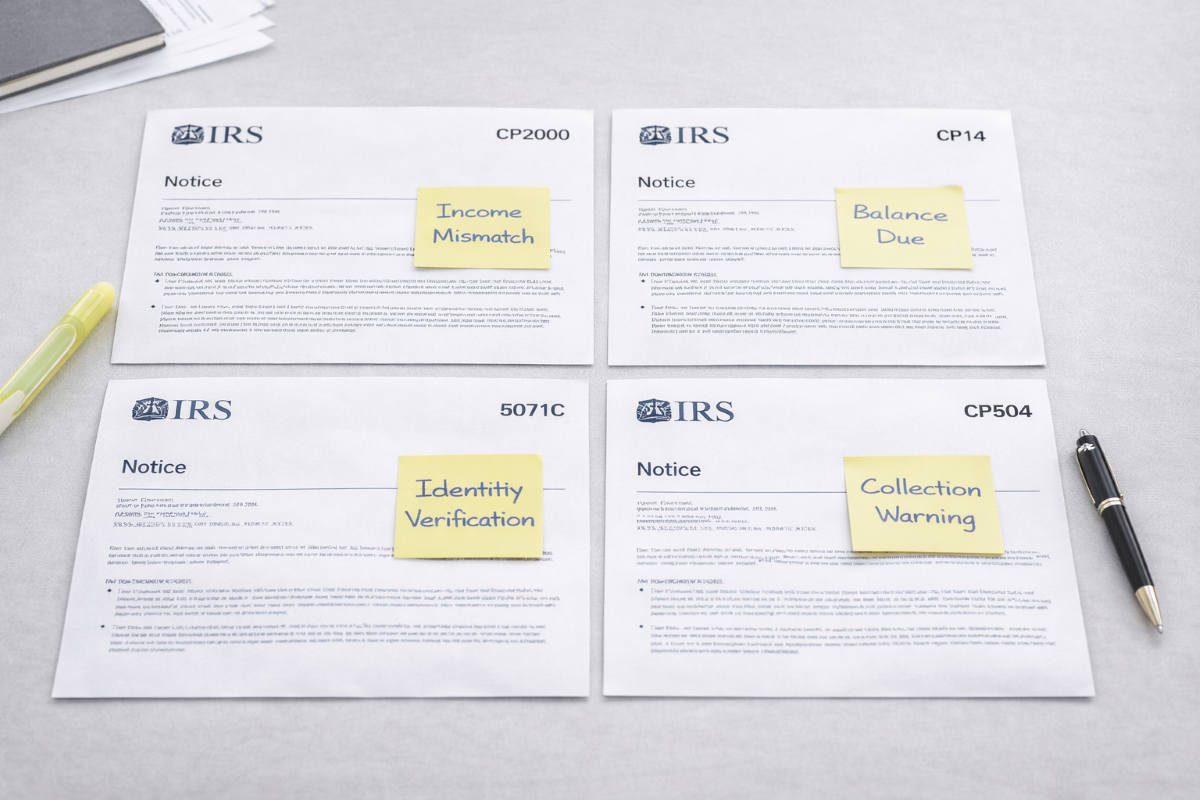
Most IRS notices fall into a handful of categories: income mismatches, balance due reminders, identity verification, or collection warnings. Each notice has a specific code in the top corner. That code tells you what kind of issue you’re dealing with. Once you know the type, the situation becomes much clearer.
Here are the ones people see most often.
What Is a CP2000 Notice?
A CP2000 means the IRS believes the income on your tax return does not match the income reported by employers, banks, or clients. It is not an audit. It is a proposed adjustment.
This usually happens when a form was missing from the return, a brokerage reported stock sales differently than expected, or a payer submitted a corrected form after the return was filed.
What happens next:
• The IRS proposes an updated tax amount
• You can agree and pay
• Or disagree and provide documentation
This is one of the most common notices sent. It’s usually resolved through clarification.
What Is a CP14 Notice?
A CP14 is a balance due notice. It means you owe money based on your filed return.
This typically happens when the tax owed was underpaid, a payment was not received or applied correctly, or withholding during the year was insufficient.
What happens next:
• The IRS adds interest from the original due date
• You can pay in full
• Or request a payment plan
This notice is informational. It is not enforced yet.
What Is Letter 5071C (Identity Verification)?
Letter 5071C asks you to verify your identity before the IRS processes your return.
This usually happens when the IRS fraud filters flag a return for possible identity theft or detect unusual filing patterns.
What happens next:
• You verify your identity online or by phone
• Once verified, processing continues
This letter is protective. It does not mean you committed fraud.
What Is a CP504 Notice?
A CP504 is more serious. It is a notice of intent to levy state tax refunds or other assets.
This generally happens when earlier balance due notices were ignored or when the IRS did not receive a response or payment.
What happens next:
• The IRS may begin collection action
• You still have time to respond before the levy begins
This is where attention matters. Ignoring it allows the situation to escalate.
What Does an IRS Audit Letter Look Like?
Audit letters are different from automated notices.
They usually:
Use the word “examination.”
Identify specific tax years
Request documentation
Provide a response deadline
Common audit letters include:
Letter 2205 (initial contact)
Letter 566 (documentation request)
Audits are less common than automated notices. And most audits are correspondence audits, meaning they’re handled by mail.
How Do I Know Which Notice I Have?
Start by looking at a few key details in the letter. Check the notice number in the top right corner. Look at the tax year referenced. Pay attention to whether the letter mentions a “proposed change” or an “examination.” Also, see whether it asks you to provide documentation.
Those clues usually tell you what category the notice falls into.
In most cases, the letter relates to a correction, a balance due, an identity verification request, or an audit review.
Once you identify the category, the next step becomes much clearer.
Does This Mean I’m Being Audited?
Usually, no. Most IRS letters are automated notices, not audits. An audit is a formal examination of your tax return. A notice is often just a correction, clarification, or balance reminder. The wording of the letter tells you which one you’re dealing with.
Here’s how to tell the difference.
What Is an IRS Audit, Exactly?
An audit means the IRS is reviewing specific parts of your return to verify accuracy.
There are three types:
Correspondence Audit – Handled by mail. The IRS asks for documents to support a deduction or income item.
Office Audit – You meet with an IRS agent and bring the requested records.
Field Audit – The IRS visits your home or business. This is the least common.
Most audits are correspondence audits. They focus on one issue, not your entire financial life.
How Is an Audit Letter Different from a Notice?
An audit letter will:
Use the word “examination.”
Reference a specific tax year
Request documentation
Provide a response deadline
Identify an examiner or audit unit
Automated notices (like CP2000 or CP14) usually:
Propose changes
Show recalculated tax
Do not request a full documentation review
Do not assign an examiner
That difference matters.
How Common Are Audits?
Audits are far less common than people think.
For most individual taxpayers, the audit rate is well under 1%. Even for small business owners, the majority will never experience a formal audit.
Higher risk categories include:
Very high-income earners
Returns with unusually large deductions relative to income
Repeated losses on Schedule C
Large charitable deductions without documentation
But even then, most returns are never examined.
What Triggers an Actual Audit?
Common triggers include:
Significant income underreporting
Large discrepancies between reported income and third-party forms
High deductions compared to income
Cash-heavy businesses
Repeated net losses
That said, many audits are also random or algorithm-based.
If you received a routine notice, it does not automatically increase your audit risk.
If It Is an Audit, What Happens Next?
You will:
Receive written notice
Be told what documents to provide
Have time to respond
Either resolve the issue or receive a proposed adjustment
You are allowed to respond in writing.
You are allowed to disagree.
You are allowed representation.
An audit is a process. It is not immediate punishment.
Most IRS letters are not audits.
But ignoring notices can increase the seriousness of a situation.
What Happens If I Ignore an IRS Letter?
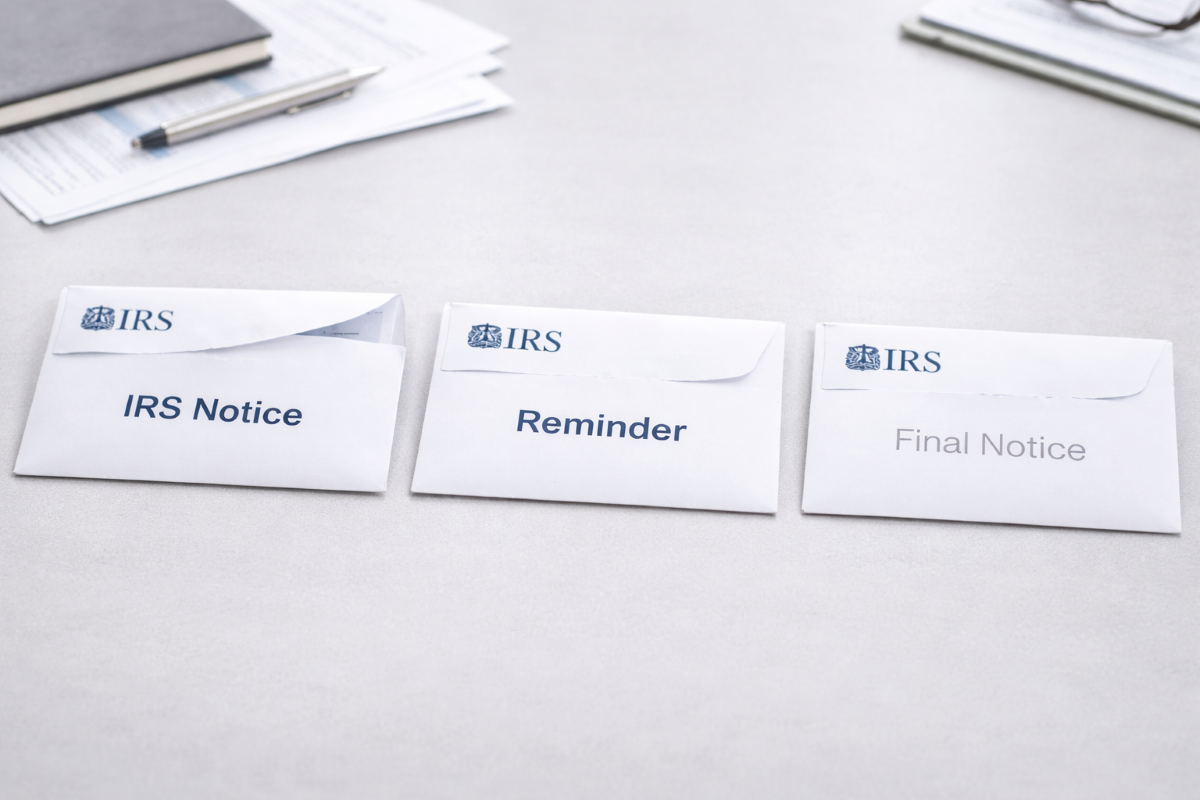
Ignoring an IRS letter usually makes the situation worse. Most notices start simple. If there’s no response, they escalate. Penalties increase. Interest continues. Eventually, the IRS may begin collection action. The earlier you respond, the more options you have
Here’s How Escalation Typically Works
Step 1: Initial Notice
The first letter usually explains the issue, proposes a correction or balance, and provides a response deadline.
At this stage, the situation is still administrative.
You can:
• Agree and pay
• Disagree and respond with documentation
• Request a payment plan
Nothing severe has happened yet.
Step 2: Reminder Notices
If the first notice is ignored, the IRS sends follow-up letters.
These reminders usually add penalties, add interest, and shorten the response timelines.
This is where costs start increasing. The original issue is still fixable, but the numbers grow.
Step 3: Final Notice or Intent to Levy (Example: CP504)
If multiple notices go unanswered, the IRS may issue a Final Notice.
This may include:
• Intent to levy bank accounts
• Intent to garnish wages
• Intent to seize state tax refunds
This does not happen after one missed letter. It happens after repeated non-response.
Even at this stage, you still have response rights. But urgency becomes real.
What About Liens?
A federal tax lien may be filed if a balance remains unpaid and unresolved.
A lien:
Secures the government’s interest in your property
Can impact credit
Makes selling assets more complicated
Again, this happens after extended non-response.
Why Ignoring It Feels Easier (But Isn’t)
People often ignore IRS mail for simple, human reasons. Sometimes they feel overwhelmed and don’t know where to start. Others assume the notice must be a mistake and will resolve itself. Some people worry about the amount listed, while others simply don’t understand what the letter is asking for.
That reaction is common.
But the IRS system runs on deadlines. Silence is treated as agreement.
The Better Approach
When you receive a letter:
Open it immediately
Identify the notice type
Check the deadline
Decide whether you agree or disagree
Respond before the due date
Even a simple acknowledgment is better than silence.
Ignoring the letter removes options. Responding preserves them.
What Should I Do Immediately After Receiving an IRS Notice?

First, read the notice completely. Most IRS letters are resolved by understanding what the issue is and responding before the deadline. Acting early keeps the situation simple. Waiting makes it more expensive and more complicated. If you want to avoid situations like this in the future, these tax reminders for a stress-free filing season can help you stay ahead of key deadlines and common filing issues.
Here’s the Step-by-Step Approach
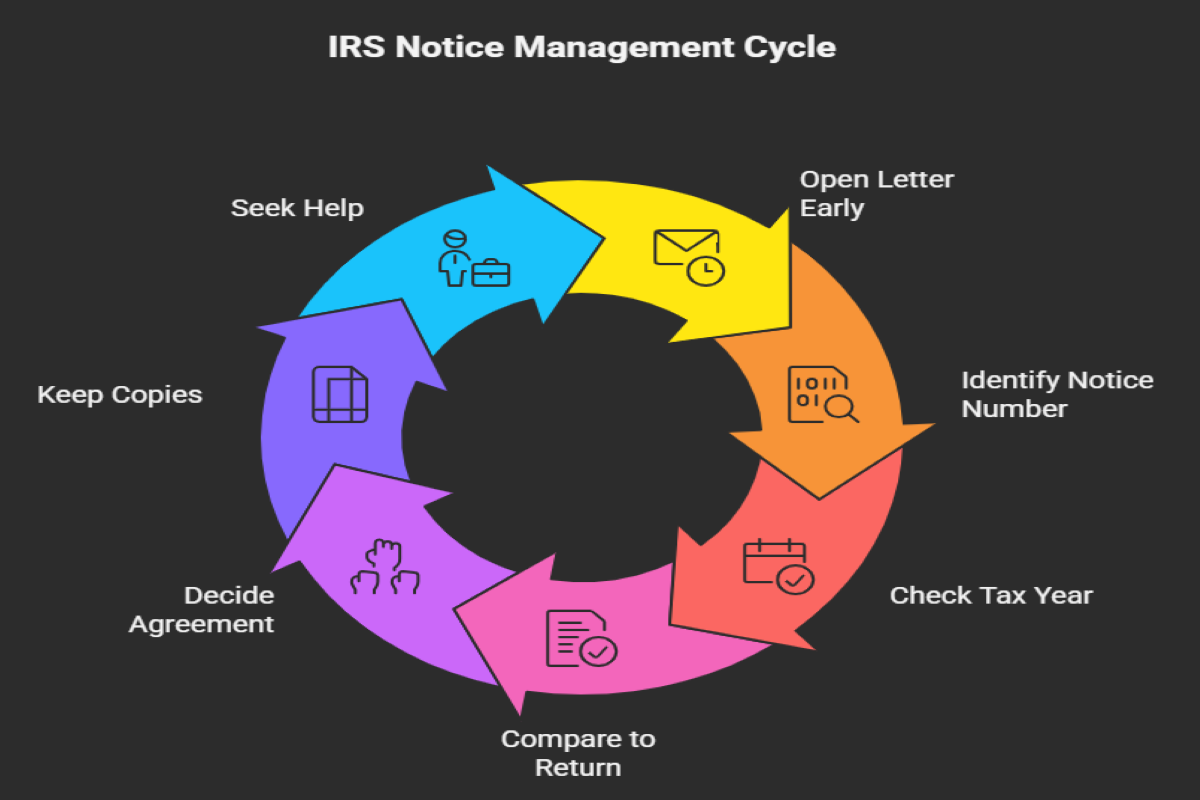
1. Open the Letter Right Away
Don’t set it aside. The deadline printed on the notice matters. Most responses are required within 20 to 30 days. Even if you’re not sure what it means yet, opening it early gives you more options.
2. Identify the Notice Number
Look at the top right corner of the letter. You’ll usually see a code such as CP2000, CP14, CP504, or 5071C. That code tells you what category of issue you’re dealing with, whether it’s an income mismatch, a balance due, a collection warning, or an identity verification request. This determines your next move.
3. Check the Tax Year Referenced
Make sure the notice applies to the correct year. It’s common for people to assume the letter is about the current year when it’s actually tied to a return filed two years ago.
4. Compare It to Your Filed Return
Pull a copy of the tax return for the year listed and compare the details carefully. Start with the income totals. Then review any deductions being questioned, credits that were adjusted, and payments that were applied. Many notices come down to a form you forgot was issued or a number that doesn’t match what the IRS received. If something looks off, that is usually where the issue starts.
5. Decide Whether You Agree or Disagree
If you agree with the notice, follow the payment instructions or set up a payment plan if needed. If you disagree, gather your documentation and submit a written response before the deadline. Silence is treated as agreement. A response preserves your rights.
6. Keep Copies of Everything
Save the original notice, your response, any documentation you send, and proof of mailing or submission. IRS systems are large, and good records protect you.
7. Know When It’s Worth Getting Help
A professional review is worth considering when the amount is large, the notice involves multiple years, the issue is tied to a business return, the letter is an audit notice, or it references a levy or lien action.
Many notices are simple. Some require a more strategic response.
The important thing is this: respond early, not emotionally.
What If I Made a Mistake on a Past Tax Return?
Mistakes on tax returns are common. The IRS knows that. If you discover an error, you can usually correct it by filing an amended return. Fixing a mistake voluntarily is almost always better than waiting for the IRS to find it.
Here’s how it works.
What Counts as a Mistake?
Common examples include:
Leaving off income
Missing a 1099
Claiming the wrong filing status
Forgetting a deduction or credit
Entering incorrect numbers
Misreporting business expenses
Some mistakes increase your tax.
Some reduce it.
Both can be corrected.
How Do You Fix It?
You file Form 1040-X, which is an amended return.
The process:
Identify the correct numbers
Complete the amended return
Explain what changed
Submit electronically (if eligible) or by mail
You generally have three years from the original filing date to claim a refund. If you owe additional tax, it’s better to correct it sooner to limit penalties and interest.
Will Amending Trigger an Audit?
Not automatically.
Amended returns are common. Filing one does not signal wrongdoing. In fact, correcting an error proactively can reduce risk compared to ignoring it.
The IRS reviews amended returns, but that’s not the same as a formal audit.
What If the IRS Already Sent a Notice?
If you receive a notice about the same issue, start by following the instructions provided in the letter. Do not file a second return unless the notice specifically tells you to do so. In most cases, the correct approach is to respond directly to the notice with the requested documentation or an explanation.
Sometimes responding to the notice is more appropriate than filing an amended return.
What About Business Returns?
If the issue involves business income or filings, the correction process can become more technical. This often applies to situations involving Schedule C income, S-corporation or partnership filings, or payroll tax reporting.
Business owners usually benefit from reviewing income reconciliation, expense categorization, and prior payroll filings to identify where the mismatch occurred.
Fixing errors early prevents compounding penalties.
Mistakes are normal.
Ignoring them is what creates escalation.
If You’re Holding an IRS Letter Right Now

If you’re reading this because an envelope is sitting on your counter, that’s normal.
Most people don’t search this topic casually. They search for it because something feels unsettled.
Here’s what matters:
You’re not behind.
You’re not automatically in trouble.
And this is almost always manageable.
But you also don’t have to decode it alone.
Here’s the Real Relief
What actually lowers stress isn’t more Googling.
It’s knowing:
Whether this is routine
Whether the amount is correct
Whether the deadline matters
And what is the cleanest next step is
That clarity changes everything.
Let’s Make This Simple
If you received an IRS letter and want certainty about what it means, we’ll review it with you.
We’ll tell you:
If it’s minor
If it needs a response
If the numbers are off
Or if it requires a strategy
If it’s simple, you’ll know.
If it needs handling, we’ll take it from there.
No pressure. No escalation language. No scare tactics.
Just a clear answer and a plan.
Because Most IRS Problems Aren’t About the Letter
They’re about uncertainty.
Once you understand what you’re looking at, the weight usually drops fast.
And if it doesn’t, that’s when we step in.