

Before You File: 10 Things Worth Checking Once More
Should You File Now or Pause to Review? Why Last-Minute Tax Doubts Happen
Sitting at your desk with your hand hovering over the submit button while your stomach tightens isn't a sign that you did something wrong. Most people freeze up right at the finish line because tax rules change every year, forms trickle in from different places, and nobody wants a surprise notice showing up in their mailbox. That pause isn't a mistake it just means you're smart enough to know that small oversights turn into real headaches once a return enters the IRS system.
Taxes feel Confusing when information is scattered across banking apps, physical mail, payroll dashboards, and messy folders. When you have to manually pull numbers from six different places, it is natural to wonder if an expense slipped through or if an income form got missed. Taking ten minutes to run through a deliberate check removes that uncertainty before anything becomes official.
A quick final pass isn't about redoing your entire return from scratch or second-guessing every single receipt. It's about catching the small mechanical snags that trigger automated IRS flags like an overlooked $600 contractor 1099, an unlinked business schedule, or a single transposed digit in your direct deposit routing number. Taking ten minutes to run through these key areas now ensures your numbers match third-party records and keeps you from leaving allowable deductions on the table.
1. Confirm Your Personal and Dependent Identification Details
A surprising number of delayed tax returns come down to a single mistyped number or a misspelled name. When you submit your return electronically, the IRS automated systems immediately cross-check the name, Social Security Number (SSN), or Individual Taxpayer Identification Number (ITIN) for every person listed against records from the Social Security Administration. If a single digit is swapped or a last name doesn't match what is on file, the entire return gets rejected within seconds.
This usually happens after big life changes that haven't caught up with government records yet. If you recently got married, changed your legal last name, or had a baby, the name on your tax return has to match what's on that Social Security card down to the letter. If you file with a new or hyphenated last name before the Social Security Administration has it logged in their computers, the IRS's automated intake system will bounce your return right back to you.
A rejected return isn't an audit, but it stops your filing in its tracks and freezes any expected refund until the mismatch gets resolved. If the rejection happens right against the April filing deadline, it can push your return past the due date and create unnecessary late-filing headaches. For families claiming dependents, entering an incorrect digit for a child's birth date or identification number will disallow dependent credits until corrected.
The easiest way to handle this is to take two minutes to lay every physical Social Security card or official tax ID letter right next to your computer screen. Look at each name letter by letter, make sure the birthdates match the proper month and day format, and read the numbers out loud to yourself digit by digit. Taking that quick pause feels low-tech, but it ensures your return clears the IRS's automated intake gate on the very first try instead of bouncing back to your inbox.
2. Match Every Income Document Against IRS Records (W-2s, 1099s, and K-1s)

The IRS doesn't wait to read through your entire tax return before checking whether your income numbers add up. Every company that pays you whether it's an employer sending a W-2, a client issuing a 1099-NEC, or your bank reporting interest on a 1099-INT sends those same numbers straight into the IRS computer system. If the total you type into your return is even a few dollars less than what those companies already reported under your Social Security number, the IRS's automated matching computers flag the difference immediately.
This issue catches freelancers, side-hustlers, and small business owners off guard when paperwork arrives late or gets buried in an email inbox. It's common to misplace a small $600 gig contract 1099 or forget about the $45 of interest earned in an online savings account. Leaving those off your return doesn't just mean filing an incomplete form; understanding what triggers an IRS notice reveals that automated document mismatches are often the direct cause of receiving an underreporter notice like a CP2000 months down the road.
When an automated notice arrives, the IRS automatically calculates the tax owed on that missing income, tacks on interest backdated to the original filing deadline, and often adds an accuracy-related penalty. Resolving that notice means digging through old bank statements, verifying old client payments, and writing letters back to the agency to sort it out.
The best way to prevent that headache is to match your tax prep entries directly against your bank deposits before filing. Start by pulling your bank statements for the entire tax year, highlighting every 1099 or payment deposit, and confirming you have a matching tax document on hand for each one. If you suspect an institution issued a form that never showed up in your mailbox or inbox, you don't have to guess what they reported.
You can pull the exact records the government has on file by logging into your personal IRS online account at IRS.gov and navigating to the Tax Records tab. Select "Get Transcript Online," choose the current tax year, and click specifically on the Wage and Income Transcript box. This displays every W-2, 1099, and interest statement that employers, clients, and banks have already transmitted under your Social Security number. Comparing that official report against the income listed on your draft return takes just a few minutes and catches missing forms before automated IRS matching computers do.
3. Verify Your Filing Status Matches Your Actual Life Changes
Choosing the wrong filing status is one of the easiest ways to either overpay on your taxes or attract an immediate letter from the IRS. Your marital status and household situation on the final day of the tax year determine your filing options for the entire twelve months. Many taxpayers simply check the same box they used last year out of habit, ignoring major life events like a marriage, separation, divorce, or changes in who supports a dependent.
The risk of picking the wrong filing status works in two completely different directions depending on your home setup. If you're an unmarried parent covering more than half the bills for a qualifying child, choosing Single instead of Head of Household means leaving a higher standard deduction and friendlier tax brackets on the table. But if you claim Head of Household without meeting the support tests, or while you're still legally married without a qualified separation agreement, the IRS will flag your return, disallow those credits, and send a bill for back taxes.
Couples who tied the knot during the tax year face a critical filing fork in the road: choosing between Married Filing Jointly and Married Filing Separately. While filing jointly produces lower combined tax liability for the vast majority of households, choosing to file separately can turn into an expensive tax trap if you do it without running the actual numbers. Many couples select separate returns to keep their student loan payments low under income-driven repayment plans, only to get blindsided when they forfeit the Child and Dependent Care Credit, lose the American Opportunity Tax Credit, and see their IRA contribution limit plummet to zero if their income exceeds $10,000. Unless you have active legal separation agreements, distinct pre-existing business tax liabilities, or specialized student loan calculations that outweigh thousands in lost tax breaks, defaulting to separate returns usually just means handing extra cash back to the IRS.
Take a moment to confirm that your selected status aligns with your legal standing as of December 31. If you went through a separation, finalized a divorce, or took on primary financial support for an aging parent, review the specific household support criteria before submitting your forms. Ensuring your status reflects your actual living arrangement protects your deductions while keeping your return completely accurate.
4. Separate Business Expenses from Personal Transactions

Mixing personal spending with business accounts is one of the quickest ways to create audit vulnerabilities and lose valid write-offs. When you run a small business, freelance, or manage a single-member LLC, it is easy for small boundaries to blur. Paying for a family dinner on the company card or using a personal credit card to buy client software might seem harmless in the moment, but it creates messy records that IRS auditors view with immediate suspicion.
When an IRS auditor spots personal charges mixed into your business account, they don't just disallow those specific purchases and move on. Seeing personal spending on a business card makes an examiner question whether you're keeping accurate books anywhere, which often leads them to dig into your legitimate supply costs, equipment deductions, and travel mileage. For LLCs and corporations, that lack of separation also threatens the corporate veil that keeps your personal savings and home protected from business claims.
The most practical step to take before submitting your return is to review your categorized expense reports against your business checking and credit card statements. Look closely at categories that naturally invite scrutiny, like meals, travel, entertainment, and personal utility bills. If you find personal items that were inadvertently categorized as business expenses, adjust them out of your deductible totals and record them properly as owner distributions or draws.
Moving forward, keeping your deductions audit-proof comes down to maintaining strictly separate accounts and documenting mixed transactions before memory fades. If you have to swipe a personal card during an emergency for a genuine business expense, you need more than just the credit card statement to satisfy an IRS examiner. Snap a photo of the itemized receipt immediately, write down the specific business purpose (such as the client name, project, or operational reason), and submit a formal expense reimbursement voucher to your company.
Once you have that documentation logged, execute a formal reimbursement transfer directly from your business checking account into your personal account, labeling the bank memo with the exact voucher number. Attaching that itemized receipt, the business justification note, and the bank transfer confirmation together in your records creates a closed, airtight paper trail that proves business intent. Taking a few moments now to clean up those mixed personal expenses protects your legitimate deductions and gives you total confidence if an auditor ever comes knocking.
5. Review Vehicle and Mileage Deductions for Proper Logs
Claiming vehicle expenses without maintaining an active mileage log is one of the most common reasons business deductions get thrown out during an IRS review. When you use a personal vehicle to visit clients, deliver products, or run essential business errands, those miles are fully deductible. However, writing down a clean, round estimate like exactly 10,000 business miles creates an immediate red flag that automated audit algorithms notice right away.
The IRS expects what they call a contemporaneous log, which is just a fancy way of saying you need to track trips as they happen instead of guessing six months later. If an auditor asks for the story behind your mileage deduction and you can't show specific dates, destinations, business reasons, and actual odometer numbers, they won't hesitate to wipe out the entire write-off on the spot. That single adjustment can instantly flip an expected refund into a painful tax bill with added penalties and back interest.
You also need to make sure you aren't counting regular commuting trips as deductible business travel. Driving from your front door to your regular office or primary job site is considered a personal commute by the IRS, so those miles never count as a business write-off. Deductible travel only starts when you travel between multiple work locations, head out to a temporary job assignment, visit a vendor, or drive to meet an active client.
Before submitting your numbers, take a few minutes to compare your vehicle deduction method to your actual driving habits. You can choose between the standard mileage rate or the actual expense method, which tracks gas, insurance, and maintenance costs against your total business percentage. Confirm that you have a physical mileage log or a mileage-tracking app report that backs up your exact total before you check that box on your return.
6. Maximize Prior-Year Retirement and Health Savings Contributions

Many taxpayers assume the door closes on tax deductions the moment the calendar flips to January 1. That is not the case for tax-advantaged accounts like traditional IRAs, SEP-IRAs, and Health Savings Accounts (HSAs). The IRS gives you until the actual tax filing deadline in mid-April to fund these accounts and apply those deductions directly to the previous calendar year.
Missing this window means giving up an immediate chance to trim your taxable income for the year you're currently filing. For example, if your taxable income sits at $50,000 just crossing the threshold into the 22% federal tax bracket putting $4,000 into a prior-year Traditional IRA or HSA pulls your taxable income down to $46,000. That single move saves you $880 in federal income tax right out of the gate while keeping that top slice of your earnings out of the higher bracket. Leaving those accounts unfunded before you submit your return forfeits a dollar-for-dollar deduction that you can't retroactively claim once the April deadline passes.
Eligibility rules do require a quick check before you transfer any money. If you or your spouse are covered by a retirement plan at work, your ability to deduct traditional IRA contributions phases out at certain income levels. For business owners funding a SEP-IRA, contributions are limited to a percentage of your net self-employment earnings, which means your final bookkeeping numbers must be accurate before calculating your maximum deposit.
If you have the cash on hand and qualify, call your plan custodian right away to confirm the deposit is tagged specifically as a prior-year contribution. Claiming that deduction on your return knocks down what you owe the IRS today while keeping more of your hard-earned money working for you down the road. Locking in those numbers before you file means you aren't sending the government a single dollar more than you actually have to.
7. Account for Estimated Tax Payments and Prior-Year Overpayments
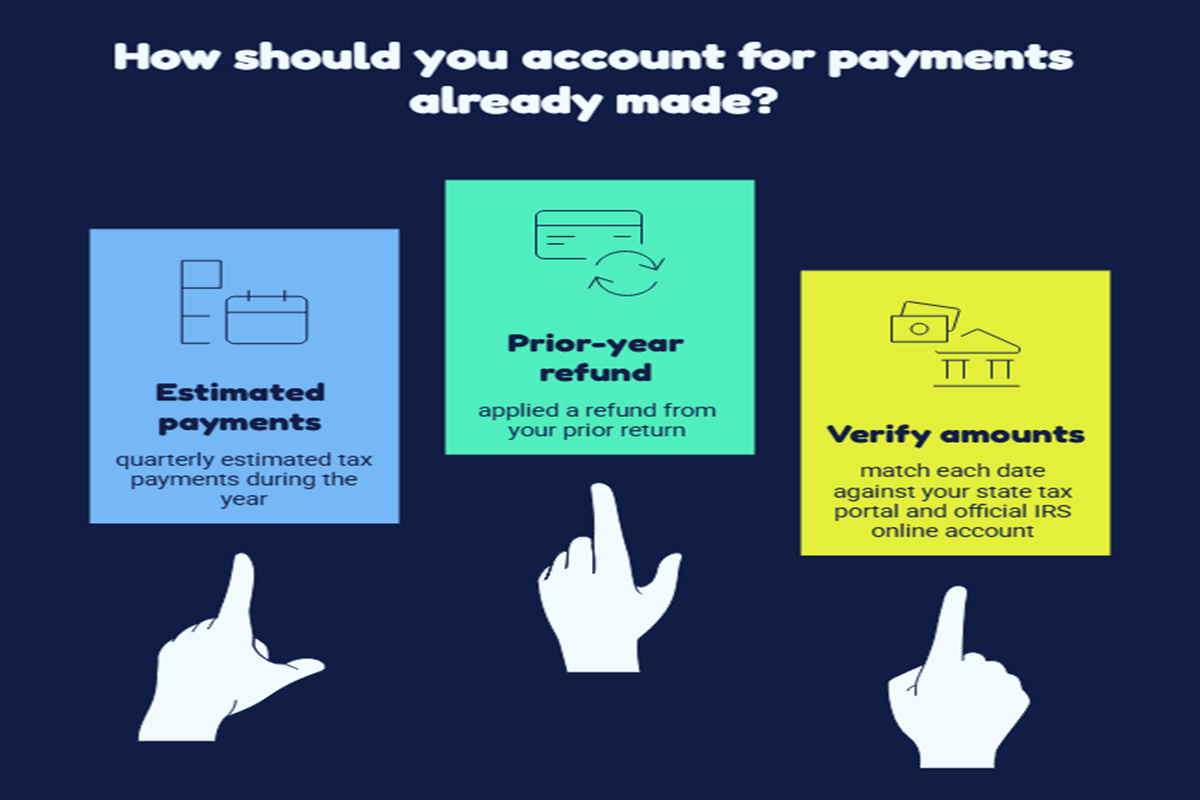
If you made quarterly estimated tax payments during the year or applied a refund from your prior return, those dollars belong on your current filing. Self-employed individuals, small business owners, and taxpayers with significant investment income frequently send these advance payments to the IRS and state agencies to stay current. Forgetting to claim these payments on your return means paying tax on the same income twice.
Leaving off an estimated tax payment causes the IRS to calculate an artificial balance due, and it won't take long for penalty and interest notices to hit your mailbox. On the flip side, guessing or entering the wrong dollar amount triggers an automated processing freeze while IRS staff manually track down what's missing. Both mistakes slow your return down to a crawl, creating weeks of back-and-forth headaches that aren't necessary if you confirm your actual cleared payments first.
The easiest way to confirm your numbers is to pull your actual bank records or check copies and match each date against your state tax portal and official IRS online account. Look at your IRS Account Transcript to see the exact cleared amounts and effective dates the agency has recorded under your Social Security number or Employer Identification Number. Making sure the amounts on your return match the cleared funds on your transcript ensures you receive full credit for every dollar already paid.
8. Confirm Eligibility for Deductions and Tax Credits
Overlooking eligible write-offs or claiming credits without meeting the exact rules is where returns most frequently run into financial surprises. Many filers take the standard deduction without comparing it to their actual itemized expenses, leaving hundreds or thousands of dollars on the table. At the same time, high-value tax credits like the Child Tax Credit, the Earned Income Tax Credit, and clean energy incentives come with strict income caps and verification rules that require attention before you file.
Taking a deduction you can't verify or miscalculating your phase-out limits does more than reduce your tax break; it prompts the IRS to recalculate your balance and issue an adjustment notice. Many of the most valuable credits begin cutting off as your modified adjusted gross income climbs. For instance, the Child Tax Credit starts phasing out at $200,000 for single filers and $400,000 for married couples filing jointly, while the student loan interest deduction phases out between $80,000 and $95,000 for single taxpayers. If your income jumped over the past year, claiming a full tax credit you no longer qualify for triggers automated flags in IRS processing.
When IRS examiners review these credits and above-the-line deductions, they don't accept rough estimates or bank statement totals alone. Claiming educator expenses requires receipts showing out-of-pocket classroom supplies alongside proof that you worked at least 900 hours during the school year in an eligible school. If you write off student loan interest, you need the official Form 1098-E issued by your loan servicer, not just your personal payment history. Gathering those third-party forms and itemized receipts before you file confirms your numbers are airtight and prevents automated processing holds.
Reviewing your deductions is a matter of doing a quick side-by-side check before locking in your numbers. If your total deductible mortgage interest, state and local taxes, and charitable gifts exceed the standard deduction threshold for your filing status, itemizing on Schedule A will yield a higher tax benefit. Verifying that your income fits within the legal brackets for any claimed credit ensures your final refund calculation is accurate and protected against processing delays.
9. Double-Check Direct Deposit Routing and Account Numbers
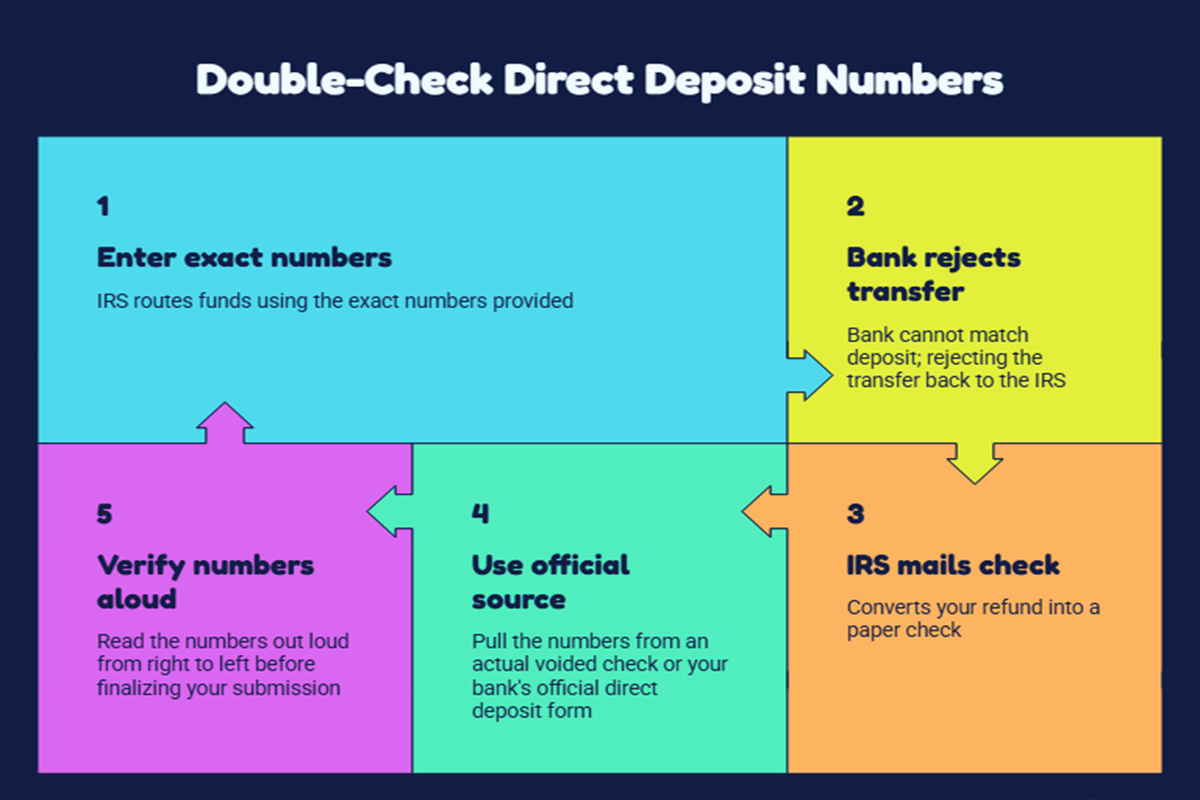
Typing in your direct deposit information is usually the last detail you tackle before filing, but a single switched number can leave your refund hanging in limbo for weeks. When the IRS releases an electronic refund, their automated network routes the payment using the exact routing and account numbers you plugged in. If just one digit is flipped or missing, the receiving bank can't match the money to your account, so their system automatically bounces the funds straight back to the government.
When an electronic deposit gets bounced back by your financial institution, the IRS automatically converts your refund into a paper check. That transition stops direct electronic processing and adds six to twelve weeks of waiting while the physical check prints and travels through the postal service. If the incorrect numbers happen to match an active account belonging to someone else, resolving that misdirected deposit involves a lengthy trace procedure with both the receiving bank and federal agencies.
The simplest way to protect your payout is to pull the numbers directly from an actual voided check or your bank's official direct deposit form rather than a debit card. Make sure you use the electronic ACH routing number, which is often different from the wire transfer routing number listed on mobile banking apps. Reading the nine-digit routing number and your full account number out loud from right to left before finalizing your submission guarantees your refund lands exactly where you expect it.
10. Review Schedules for Blank Lines, Inconsistencies, and Required Signatures
The final hurdle before your return is accepted comes down to form mechanics and signatures. Supporting attachments like Schedule C for business profit and loss, Schedule E for rental real estate, or Form 8829 for home office deductions must integrate cleanly with your main Form 1040. Leaving required identification boxes blank or carrying inconsistent line-item totals between supporting forms and your primary summary page leads to automated processing delays.
For small business owners, basic clerical oversights often trigger unnecessary questions from tax agencies. Omitting your Principal Business Activity code, forgetting to indicate whether you materially participated in operations, or reporting round-dollar accounting guesses can cause processing systems to pause your filing. Furthermore, an electronically filed return without valid digital signatures is treated as unsigned by the IRS. For married couples filing jointly, both spouses must provide their identity verification numbers and sign electronically, or the submission will fail right at the intake gate.
Taking five minutes to do one last sanity check before you hit send isn't about second-guessing your work; it's about protecting yourself from dumb software glitches and clerical snags. Grab your draft and confirm that every supporting schedule actually generated, make sure your carryover numbers transferred to the main form without dropping a zero, and double-check that you and your spouse signed every required digital box. Spending that extra moment at your desk gives you total peace of mind that your return will glide straight through IRS processing without getting kicked back.
When to File Yourself and When to Get a Second Opinion

Handling your own filing makes sense when your tax picture is straightforward and unchanged from the previous year. If you have a single W-2, take the standard deduction, and don't have business income or complex family changes, running through the steps above is usually all you need to file with clarity. But taxes become heavy when your life or your business expands, and that extra complexity often brings uncertainty.
When your business grows, your tax return stops being a simple recap of the past year and turns into a real financial puzzle. If you launched a venture, sold property, took on freelance clients, or navigated major personal changes, having an experienced professional review your draft isn't an admission that you can't handle your numbers. It's simply smart risk management that often uncovers legitimate deductions, industry-specific write-offs, and credits that basic tax software completely ignores. Bringing in a fresh pair of eyes gives you total confidence that you aren't leaving money on the table or setting yourself up for an unnecessary IRS letter later.
If you want an experienced professional to review your assembled numbers before you submit them, our team is here to help. You can schedule a 2nd Opinion Tax Review with Trustway Accounting, and we will walk through your return together to make sure everything is handled properly.