

Why Your Tax Return Can Be Correct and You Can Still Be Missing Opportunities
Does an IRS-Accepted Tax Return Mean You Paid the Lowest Legal Tax?
You get the notification that your federal and state tax returns were officially accepted by the IRS. It feels like a massive relief because there are no calculation errors, no red flags, and you survived another tax season. But as you look at the final number you owed, that familiar, sinking feeling creeps in. You can't help but wonder if you just handed over way more of your hard-earned money than you actually needed to.
This is more common than you think, and you didn't necessarily mess anything up. The confusion happens because most people assume an accurate tax return is the exact same thing as having a clear tax plan. In reality, a mathematically perfect return just means the numbers on your forms match the receipts and records you handed over. It doesn't mean those numbers were set up in a way that keeps more of your money in your pocket.
Relying on DIY tax software or a high-volume seasonal preparer creates a false sense of security. These tools and transactional services are designed to look backward and report what already happened after the year is over. They are not built to ask you proactive questions about how your business is growing or how you should structure your income. Because of this gap, completely legal and highly impactful tax savings are left untouched every single year.
Tax Preparation vs. Tax Strategy: The Difference Between Looking Backward and Looking Forward
Tax preparation records what already happened after the year ends to keep you compliant with the IRS, while tax strategy makes intentional financial decisions before December 31 to lower what you owe.

When business owners and professionals think about taxes, they usually picture the April rush to gather documents and get everything filed on time. The problem is that focusing only on the filing deadline means you're already too late to change the outcome. By the time you hand your paperwork over, the year is closed and your financial history is permanently set.
Tax preparation is strictly a compliance exercise that looks backward at what already happened. A traditional preparer takes your receipts, enters your historical data into the right forms, and tells you what you owe the government. Their job is to keep you out of trouble with the IRS by accurately reporting the past, not to find ways to keep more money in your pocket.
Tax strategy is a completely different process that looks forward while the year is still open. It involves making deliberate financial decisions, like adjusting how you pay yourself or timing large business purchases, before December 31 hits. Because the year is still active, you actually have the power to lower your tax liability instead of just reporting it.
Most traditional accountants miss this completely because their business model relies on churning through high volumes of returns during a very short window. They simply don't have the time to sit down with you in October to review your books and suggest structural improvements. If you want proactive advice that actually saves you money, you need a professional relationship that supports year-round conversations rather than a once-a-year transaction.
Where Profitable Businesses and Self-Employed Filers Overpay Without Triggering IRS Red Flags
It is entirely possible to run a highly profitable, compliant business and still lose thousands of dollars a year to structural tax inefficiencies. When you only interact with a tax professional in April, they are simply reporting the financial structure you operated under for the previous twelve months. If that structure is outdated or if you categorized your spending incorrectly, you will legally overpay, and the IRS will happily accept the check without ever raising a red flag.
Outgrowing Your Initial Entity Structure
When you first start making money, operating as a sole proprietor or a single-member LLC is the simplest way to get off the ground. However, as your net income crosses the $60,000 to $100,000 threshold, staying in that default structure becomes an expensive operational mistake. At that level, every dollar of profit is subject to self-employment taxes, which can quickly drain the cash flow you need to hire help or scale.
Switching to an S-Corp lets you split your income between a reasonable salary and owner distributions, so you aren't paying self-employment taxes on every single dollar you make. The catch is you've got to set up that election ahead of time, which means running regular payroll and keeping cleaner books throughout the year. If you wait until tax season to bring it up, your preparer can only file for the business structure you had in place, meaning you've already missed your window to save that money.
Misclassifying Expenses and Missing Industry-Specific Deductions
Most small business owners and freelancers keep their books just clean enough to hand over a profit and loss statement at year-end. When you use broad, generalized bookkeeping categories, you accidentally bury legitimate business deductions. A rushed tax preparer isn't going to dig through a generic "office expenses" or "miscellaneous" category to find out if you qualify for specialized industry deductions or equipment depreciation.
This often leads to completely missing out on home office deductions, accurate vehicle mileage calculations, and the Section 199A Qualified Business Income deduction. These are not loopholes; they are standard structural benefits designed for business owners. But you have to track the data correctly throughout the year to prove you qualify, and you cannot reverse-engineer that proof in a panic on April 14th.
Uncoordinated Personal and Business Cash Flow Decisions
Business owners frequently make the mistake of treating their personal finances and business cash flow as two completely isolated worlds. When you pull money out of your business without a plan, you risk pushing yourself into a higher personal tax bracket unnecessarily. A proactive strategy looks at the total picture, balancing owner draws, W-2 salary, and year-end distributions to keep your overall liability as low as possible.
Without this coordination, you might skip making a qualified retirement contribution simply because your business account looks a bit low that month, missing a massive deduction. Or, you might buy a piece of heavy equipment in January when buying it in December would have wiped out a huge tax bill for the current year. These are timing and cash flow decisions that require year-round visibility, not a retroactive review.
The Year-Round Tax Strategy System: A 3-Step Operating Rhythm for Business Owners
Moving from reactive April filing to proactive tax strategy doesn't require learning the tax code yourself. It just means installing a repeatable, four-quarter operating rhythm so financial decisions happen while the calendar year is still open. When your tax moves follow a scheduled system, saving money becomes a normal business routine instead of a year-end panic.

Step 1: Reconcile Books Monthly to Produce Decision-Ready Numbers
A reliable tax strategy can't run on disorganized bank feeds or accounts that haven't been reconciled in three months. Closing your books at the end of each month gives you an accurate profit and loss statement that reflects how your business is actually performing. When your numbers stay current, spotting deductions and tracking expense trends happens naturally instead of in an April rush.
Step 2: Run Mid-Year and Q3 Check-Ins to Calibrate Payments and Forecast Profit
The next phase of the system takes place in June and October, where you sit down to compare your real net income against your yearly projections. If revenue spiked unexpectedly, you can adjust your quarterly estimated payments on the spot so you don't get hit with an underpayment penalty or a surprise balance. These structured checkpoints give you the runway to plan major purchases, manage cash flow, and make adjustments while the year is still active.
Step 3: Calibrate S-Corp Compensation and Lock in Deductions Before December 31
During the fourth quarter, the system shifts to dialing in your owner pay and locking in pre-year-end deductions. If you operate an S-Corporation, this is when you review your distribution-to-salary ratio to ensure your W-2 wage is defensible without overpaying self-employment taxes. It's also the hard cutoff to set up qualified retirement accounts like a Solo 401(k) or SEP IRA, making sure your hard-earned revenue builds personal wealth rather than going to taxes.
How the 2nd Opinion Tax Review Recovers Missed Opportunities From Prior Open Years
Under IRS rules, businesses and individuals can generally amend tax returns up to three years back to claim missed deductions and recover overpaid funds.
Most people assume that once a tax return is submitted and the payment clears, those dollars are gone forever. If you realize you missed deductions or used the wrong business structure two years ago, it is easy to assume you just have to live with the loss. The reality is that the tax code gives you a clear, legal path to look backward and fix past oversights.
The IRS generally allows you to amend tax returns up to three years from the date you filed the original return, or two years from the date you paid the tax, whichever is later. By filing Form 1040-X for individual returns or Form 1120-X for corporate returns, you can correct previous omissions and claim refunds for money you overpaid. Discovering an overlooked tax opportunity today isn't just useful for next year; it can put cash directly back into your bank account right now.
A second opinion tax review isn't about second-guessing basic math or taking aggressive positions that trigger audit flags. Instead, a tax professional examines your past two to three years of returns to evaluate whether your filings actually reflected your business reality. We look for missed depreciation schedules, unapplied business tax credits, and common deduction gaps that generic software or rushed preparers overlooked.
Reviewing prior returns also establishes a clean baseline for your ongoing tax strategy. Once past discrepancies are corrected and your records are aligned, building a forward-looking plan becomes straightforward. You stop wondering whether you paid too much in previous years and gain a clear path forward for keeping your tax bill as low as legally possible.
Why Do Businesses Overpay on Taxes Without Realizing It?
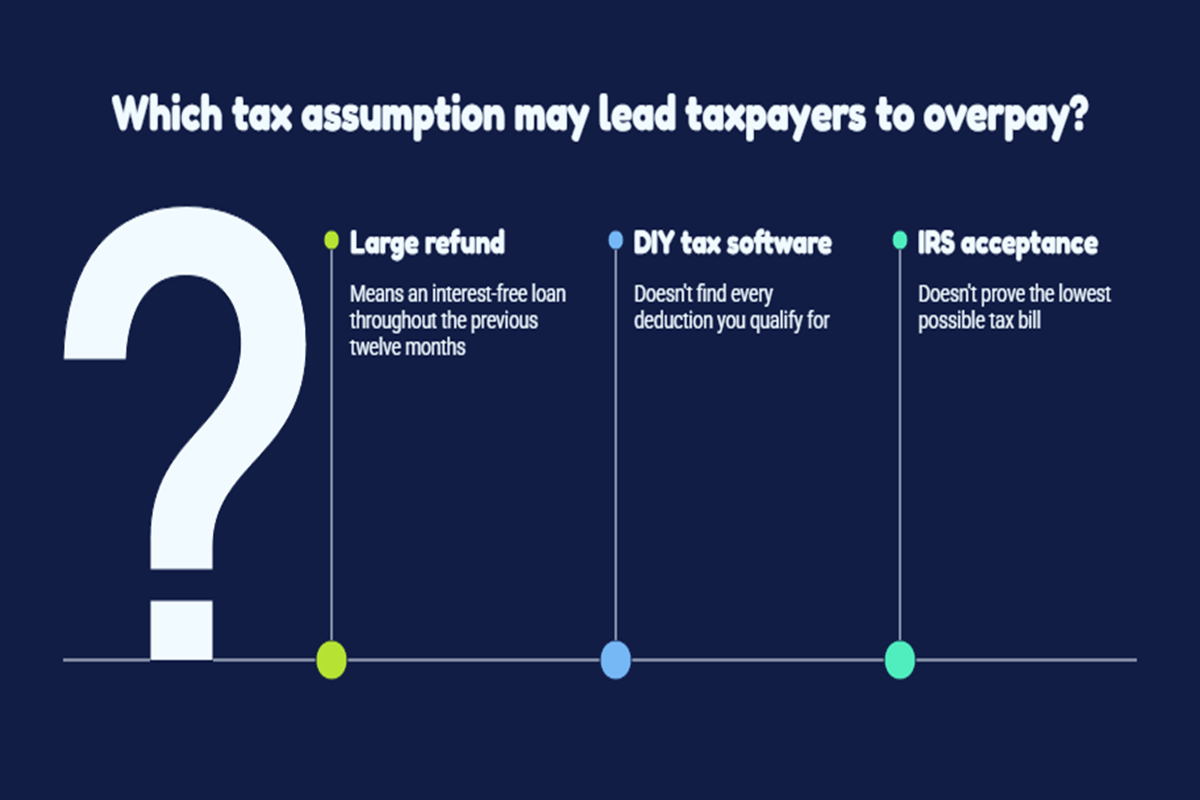
Business owners routinely overpay on their taxes because they judge their filing by whether they received a refund or avoided an audit, rather than whether their business was set up to minimize what they owe. When you only look at your numbers once a year in April, it's easy to rely on surface signals that feel reassuring but hide major financial leaks. An accepted return or a spring refund check just tells you what happened after the fact it doesn't prove that you kept as much money in your business as legally possible.
Believing a Large Refund Means Your Filing Was Optimized
Getting a massive refund check in the spring often feels like an undeniable win. In reality, a large refund usually means you gave the government an interest-free loan throughout the previous twelve months. That cash could have stayed in your operating account, funded payroll, or helped you manage everyday expenses during slower months.
A forward-looking tax strategy aims to bring your year-end tax balance as close to zero as possible. When your quarterly estimated payments and payroll withholdings are calibrated correctly, you keep your money working for you all year long. You don't have to wait on an IRS processing schedule just to access cash that belonged to you from the start.
Assuming DIY Tax Software Finds Every Deduction You Qualify For
Tax software is built to function as a digital intake form, not an advisor. It calculates your numbers based on the information you type into each field, but it cann’t evaluate what you left out. The software doesn't know you used personal assets for business tasks or that you qualify for home office deductions unless you already know how to claim them.
It also cannot analyze how your business is growing or recommend changing your tax structure to protect your profit. Algorithms simply process historical data without understanding your future goals or industry nuances. Relying on software prompts leaves you to figure out complex tax strategies on your own, which is where deductions get missed.
Treating IRS Acceptance as Proof of the Lowest Possible Tax Bill
The IRS reviews your filed return to verify that your math is accurate and that your reported income matches third-party records. Their review systems check for compliance and underreported revenue, not whether you minimized your bill. They won't review your forms to make sure you claimed every deduction or credit you were legally entitled to receive.
If you report your full revenue but forget to deduct legitimate expenses, the government simply accepts the overpayment. There is no automated alert from the IRS telling you that an alternative filing method would have cut your tax bill in half. An accepted return confirms that your paperwork met legal filing standards, not that your tax burden was reduced as much as the law allows.
Schedule a Tax Appointment to Review Your Filing and Plan Ahead

Feeling uncertain about whether you overpaid on your past tax returns is completely normal, and it doesn't mean you made a mistake. When you don't have a year-round advisory process in place, it's natural for filings to focus solely on getting forms submitted before the deadline. The good news is that past oversights are fixable, and you don't have to navigate upcoming tax decisions on your own.
Trustway Accounting helps individuals and business owners turn taxes from an annual surprise into an organized financial advantage. Through a 2nd Opinion Tax Review, we review your past two to three years of returns to identify missed deductions, outdated entity structures, and overlooked tax credits. We help you recover money that should have stayed in your bank account while building a clean, forward-looking strategy for the current year.
If you want another set of eyes on your prior filings or want to put a proactive plan in place before the year closes, we're here to help. Schedule a tax appointment with our team today to review your numbers, get clear answers to your questions, and take the uncertainty out of your taxes.
Frequently Asked Questions About Tax Strategy and Return Accuracy
Can a tax return be mathematically correct and still result in overpaying?
A tax return can be completely accurate according to IRS filing standards while still causing a taxpayer to overpay thousands of dollars. Mathematical accuracy simply confirms that the figures entered on tax forms match the historical records and income documents submitted to the tax preparer. It doesn't evaluate whether the taxpayer chose the most advantageous business structure, timed deductions effectively, or claimed every available tax credit before the close of the tax year.
Traditional tax preparation focuses strictly on reporting past financial data to ensure IRS compliance. In contrast, proactive tax planning evaluates income distribution, entity classification, and qualified deductions while the tax year is still open. This forward-looking process prevents legal overpayments from occurring in the first place and keeps more revenue inside the business.
How far back can a business owner or individual amend a tax return to recover overpaid taxes?
The IRS generally allows taxpayers to amend previous federal tax returns within three years from the date the original return was filed, or within two years from the date the tax was paid, whichever date is later. Business owners file Form 1120-X and individual taxpayers file Form 1040-X to report missed deductions, adjust expense categories, or apply overlooked tax credits from prior open years. Conducting a second opinion tax review allows taxpayers to identify past filing gaps and legally request a refund for money that was overpaid.
When should a small business transition from an LLC to an S-Corporation for tax purposes?
A small business typically benefits from electing S-Corporation tax status once net business profits consistently reach between $60,000 and $100,000 per year. Below that earnings threshold, the administrative costs of running payroll, filing separate corporate returns, and keeping up with compliance often outweigh the potential tax savings. Once net profit crosses that benchmark, splitting income between a reasonable W-2 salary and owner distributions helps business owners legally lower self-employment taxes.
What is the primary difference between seasonal tax preparation and ongoing tax strategy?
Seasonal tax preparation is a backward-looking compliance service that records historical transactions after the tax year has already ended. Ongoing tax strategy is a forward-looking process that helps taxpayers make intentional operational, retirement, and cash flow decisions throughout the active calendar year. By connecting monthly bookkeeping data to regular mid-year check-ins, taxpayers can lower their overall tax liability before December 31 instead of reacting to surprise bills in April.