

The Monthly Accounting Close Checklist for Growing Small Businesses
Your business does not need to be in financial trouble for the books to become harder to manage.
As sales, expenses, customers, employees, and accounts increase, small gaps can begin to pile up. A missing receipt becomes an uncategorized expense. An unpaid invoice stays unnoticed. A credit card balance does not match the accounting records. By the time someone reviews the reports, the information may already be several weeks behind.
A monthly accounting close helps prevent that drift.
The process brings the completed month into focus. Transactions are recorded, accounts are reconciled, outstanding balances are reviewed, and financial reports are checked before the business moves forward.
This does not need to become a long, technical exercise. What matters is having a consistent process that produces reliable information while there is still time to use it.
A completed monthly close can help you understand:
How the business performed
How much cash is available
Which customers still owe money
Which bills and obligations are coming due
Whether expenses changed unexpectedly
What may require attention before the next month ends
This checklist explains the main steps in a small-business month-end close, what the owner should review, and how to build a process that remains useful as the company grows.
What Is a Monthly Accounting Close?
A monthly accounting close is the process of reviewing and finalizing the financial activity for a completed month.
It usually includes confirming that transactions are recorded, reconciling account balances, reviewing unpaid invoices and bills, making necessary adjustments, and checking the financial statements for unusual or missing information.
The goal is not simply to mark the month as finished. It is to make sure the reports reflect what actually happened.
A monthly close is different from everyday bookkeeping. Bookkeeping records activity as it occurs. The close reviews that activity as a complete period and checks whether the information is accurate enough to support decisions.
For a growing business, this creates a reliable stopping point. You can review the month, resolve open questions, and move into the next period with cleaner records instead of carrying small errors forward.
Why Growing Businesses Need a Consistent Monthly Close

As a business grows, its financial activity becomes harder to review casually.
There may be more bank accounts, credit cards, customer invoices, vendor bills, payroll transactions, loans, and payment platforms. Without a consistent closing process, missing or incorrect information can remain in the books and make the reports less useful.
A regular monthly close helps identify problems while the details are still recent. It can reveal:
Transactions recorded twice or not recorded at all
Bank or credit card balances that do not match
Customer invoices that remain unpaid
Vendor bills that have not been entered
Payroll or loan activity recorded incorrectly
Expenses that increased unexpectedly
Reports that no longer reflect how the business operates
This matters because financial reports should help you make decisions, not simply document the past.
When the month is closed on a consistent schedule, you can review cash, profitability, expenses, and upcoming obligations using information that is current enough to act on.
If the company has added services, employees, locations, or new revenue streams, the accounting process may also need to change. Read “Has Your Business Changed? Your Accounting Strategy Should Too” to learn how your reporting and financial support may need to evolve as the business grows.
The Monthly Accounting Close Checklist
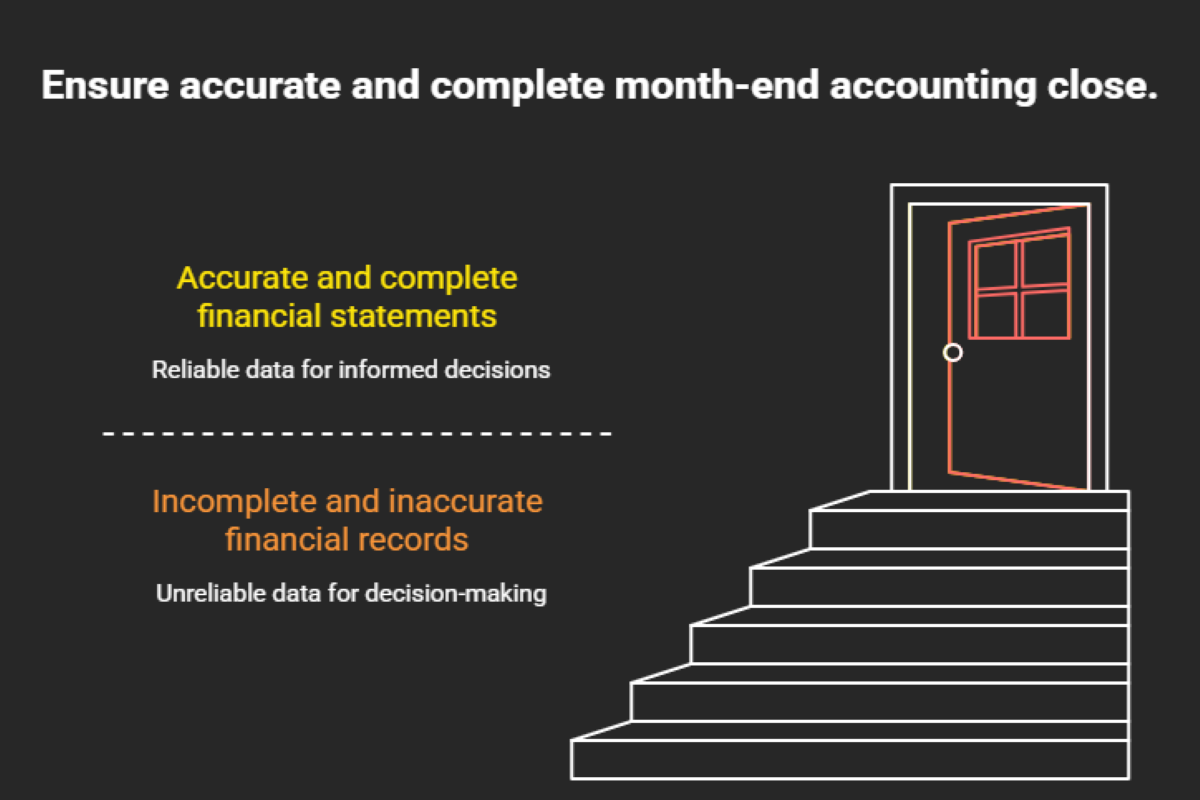
A reliable month-end close follows the same basic sequence each time. The exact details may vary by business, but the goal stays the same: make sure the month’s activity is complete, accurate, and ready for review.
1. Collect Missing Financial Documents
Gather bank and credit card statements, customer invoices, vendor bills, receipts, payroll reports, loan statements, payment processor reports, and reimbursement records.
Missing documents create blind spots, so it helps to collect them before reviewing the accounts.
2. Record and Categorize Transactions
Confirm that income, expenses, refunds, transfers, owner contributions, and owner withdrawals have been recorded correctly.
Pay close attention to uncategorized transactions or entries placed in accounts that do not reflect what actually happened.
3. Reconcile Financial Accounts
Compare the balances in the accounting system with the statements for bank accounts, credit cards, loans, and payment platforms.
Investigate differences rather than carrying them into the next month. A small mismatch can point to a duplicate charge, missing transaction, incorrect date, or recording error.
4. Review Customer Invoices and Payments
Check which invoices remain unpaid, whether customer payments were applied correctly, and whether deposits or credits are sitting in the wrong account.
This review helps the business understand what is still owed and whether follow-up may be needed.
5. Review Vendor Bills and Upcoming Payments
Confirm that vendor bills have been entered and assigned to the correct period.
Review what has already been paid, what remains outstanding, and which obligations are coming due soon. This gives a clearer view of the cash the business will need.
6. Verify Payroll Activity
Review wages, payroll taxes, benefits, reimbursements, and withdrawals related to payroll.
Make sure payroll reports agree with the amounts recorded in the accounting system. Any differences should be resolved before the month is finalized.
7. Record Necessary Adjustments
Some activity may require entries that are not captured through everyday transactions.
These may include loan principal and interest, depreciation, prepaid expenses, accrued expenses, inventory changes, or other period-end adjustments.
Not every business will need every type of adjustment. What matters is identifying the ones that apply and recording them consistently.
8. Review the Financial Statements
Once the accounts are updated, review the profit and loss statement and balance sheet.
Look for unusual balances, unexpected changes, negative amounts, duplicate expenses, or categories that do not make sense. Compare the results with the previous month, the budget, or the same period from the prior year when that comparison is useful.
9. Finalize the Month and Document Open Items
Save the final reports, note any unresolved questions, and assign follow-up responsibilities.
Once the information has been reviewed, limit unnecessary changes to the closed period. If an adjustment is needed later, document why it was made so the reporting history remains clear.
What Should the Business Owner Review Each Month?
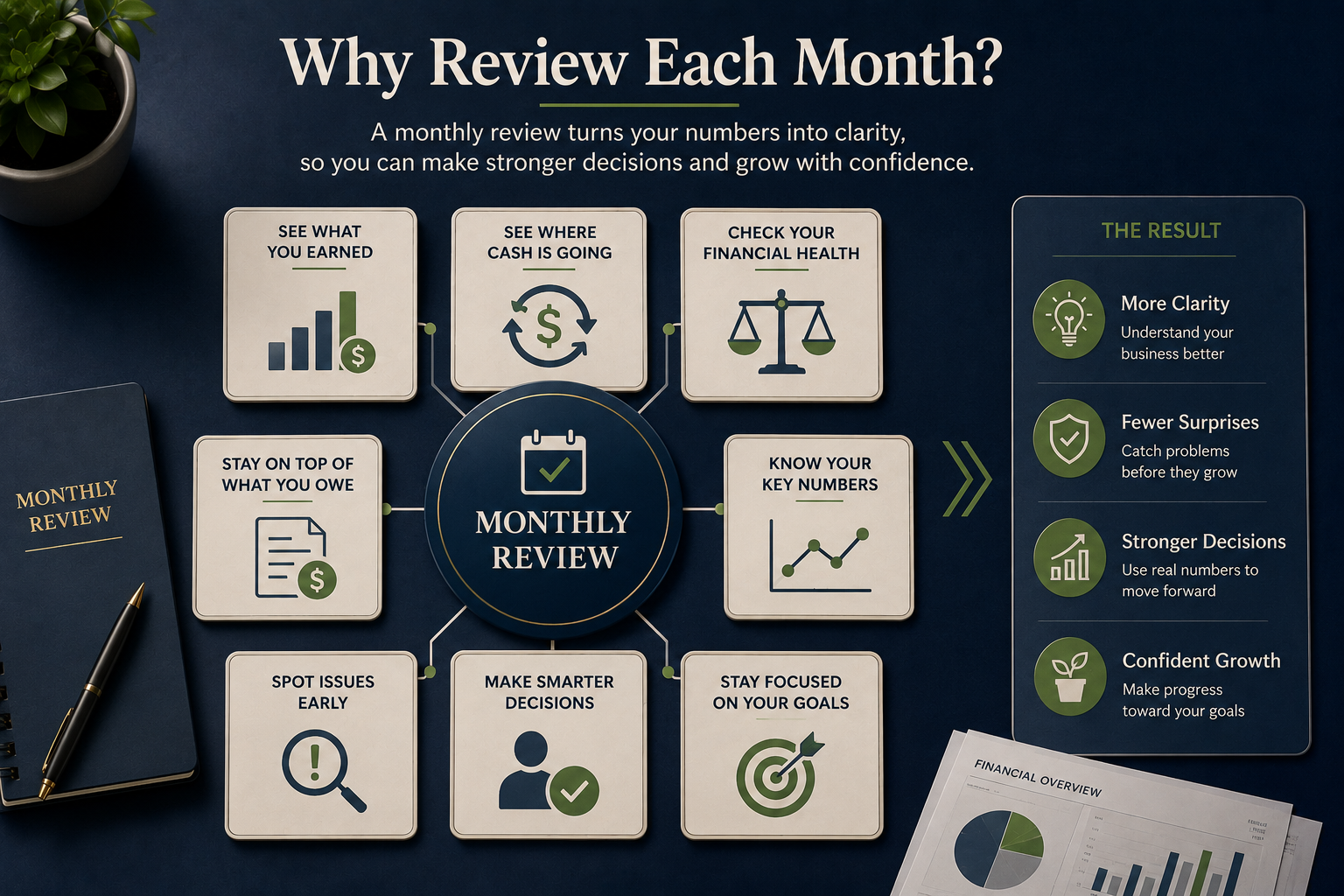
Closing the books is only part of the process. The next step is understanding what the completed reports are telling you.
A business owner does not need to study every transaction. Focus on the areas that affect cash, profitability, obligations, and upcoming decisions.
Review:
Revenue and profit: Did sales increase, decrease, or stay consistent? Did profit move in the same direction?
Cash position: How much cash is available, and is it enough to cover near-term expenses?
Unpaid customer invoices: Which balances are overdue, and are collection delays becoming a pattern?
Bills and upcoming obligations: What needs to be paid soon, including payroll, loan payments, and tax-related amounts?
Major expense changes: Did payroll, materials, software, rent, or other costs increase unexpectedly?
Budget differences: Where did actual results differ from the plan, forecast, or previous month?
Business-unit performance: Are certain services, customers, projects, or locations producing stronger results than others?
For a closer look at that final question, read “How to Track Profitability by Service, Customer, Project, or Location.”
The purpose of this review is not to explain every fluctuation. It is to identify what deserves a closer look before another month passes.
Common Month-End Close Mistakes
A monthly close becomes less useful when the process is rushed, inconsistent, or based on incomplete information.
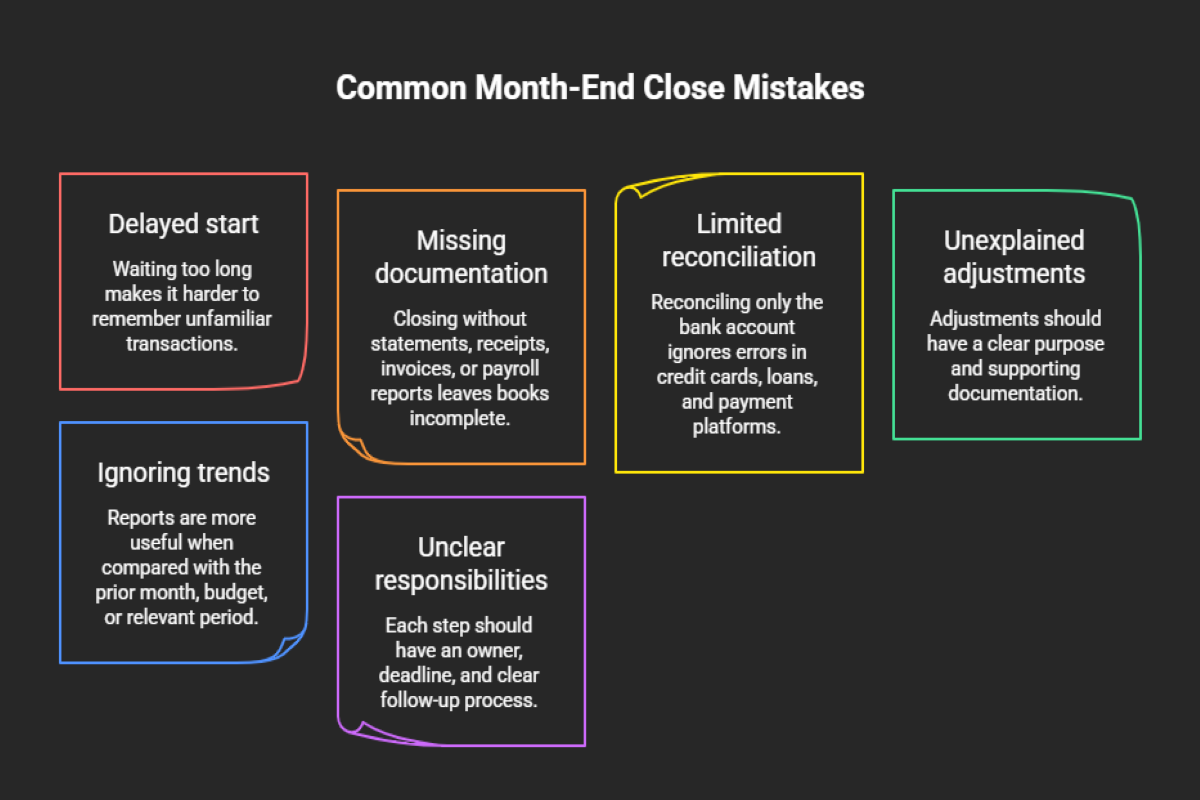
Common mistakes include:
Waiting too long to begin: The longer the delay, the harder it becomes to remember what unfamiliar transactions were for.
Closing without all source documents: Missing statements, receipts, invoices, or payroll reports can leave the books incomplete.
Reconciling only the bank account: Credit cards, loans, and payment platforms may also contain errors or missing activity.
Using unexplained adjustment entries: Adjustments should have a clear purpose and supporting documentation.
Reviewing reports without comparing trends: A report is more useful when compared with the prior month, budget, or another relevant period.
Leaving responsibilities unclear: Each step should have an owner, deadline, and clear follow-up process.
A simple process completed consistently is usually more valuable than a detailed checklist that no one can maintain.
How Long Should the Monthly Close Take?
There is no single closing timeline that fits every small business.
The time required depends on transaction volume, the number of accounts, payroll activity, inventory, loans, and how quickly supporting documents are available.
A straightforward business may be able to complete the close within the first few business days of the new month. A more complex business may need additional time to reconcile accounts, review adjustments, and resolve open questions.
The better goal is consistency, not speed for its own sake.
Set a repeatable deadline that gives the business enough time to gather complete information while still producing reports early enough to guide decisions.
A slower close may signal that records are arriving late, responsibilities are unclear, or too much cleanup is happening at month-end. Reviewing those bottlenecks can make the process more efficient without sacrificing accuracy.
Frequently Asked Questions
Does every small business need a monthly close?
Most growing businesses benefit from reviewing and finalizing their records each month. Very small or low-activity businesses may use a different schedule, but longer gaps can make errors harder to identify and reports less useful.
Who should complete the month-end close?
The work may be handled by a bookkeeper, accountant, internal employee, or a combination of people. Responsibilities should be clearly assigned so reconciliations, adjustments, reviews, and follow-up items are not overlooked.
What reports should be prepared after closing?
The main reports usually include the profit and loss statement and balance sheet. Depending on the business, cash-flow reports, accounts receivable aging, accounts payable aging, budget comparisons, or profitability reports may also be useful.
Can accounting software automate the monthly close?
Software can automate transaction imports, bank feeds, recurring entries, and some reconciliation tasks. It cannot determine whether every transaction is accurate, complete, or assigned correctly. Human review is still important.
What is the difference between a month-end and year-end close?
A month-end close finalizes one month of financial activity. A year-end close covers the full accounting year and may involve additional adjustments, tax preparation, and reporting requirements. Consistent monthly closes usually make the year-end process easier.
Build a Monthly Close You Can Rely On

A monthly accounting close gives your business a clear financial stopping point.
Instead of carrying missing transactions, unreconciled balances, and unanswered questions into the next month, you can review what happened while the information is still recent. That makes the financial reports easier to understand and more useful for planning.
The process does not need to be complicated. It needs to be consistent.
Collect the records, reconcile the accounts, review receivables and bills, confirm payroll, record necessary adjustments, and examine the financial statements. Then document anything that still requires follow-up.
As the business grows, the close may need to become more structured. Additional accounts, employees, services, projects, or locations can create more reporting needs and more opportunities for information to fall through the cracks.
Trustway Accounting can help you organize your monthly accounting process, maintain current records, and prepare financial reports that are easier to use.
Schedule an appointment with Trustway Accounting to discuss your bookkeeping, accounting, and financial reporting needs.